by Gabrielle DeSantis

When it comes to buying a new car, buying something complicated and high-tech isn’t always appealing. For some buyers, simplicity is key, and if you’re looking for affordable, subcompact cars, there are many options that offer the bare minimum — and for some drivers, that could be a good thing. Of course, with trim level and package options, you can still get all of the new standard safety features and technology that many other, more expensive vehicles have, but there’s also nothing wrong with sticking to the basics of a subcompact car.

Among the tested and rated subcompact options, the highest-scoring vehicle according to Consumer Reports is the 2021 Nissan Versa. The Nissan Versa has been a long-standing popular option among the subcompact car segment because it brings with it the reliability you would expect from a Nissan, low yearly repair and maintenance costs, and it’s a decent car for such a low price. While it won’t win any awards for being a fast or good-looking car, the 2021 model has some much-needed cosmetic updates to make it look modern even in more subtle ways than some more expensive, higher-end cars do.

For the base model MSRP of $16,435, you can expect to get:

  • Bluetooth connectivity
  • 7-inch touchscreen infotainment system
  • Automatic emergency braking
  • Rear automatic braking
  • Lane departure alerts

The 2021 Hyundai Accent comes with a bit of tech

The 2021 Hyundai Accent is a more modern option for the price range, offering drivers something basic with a bit of a flair. In all trim level options, the price for the new Accent still sits comfortably under the $20,000 making it among the most affordable cars that you can buy brand new, and it does have many features and options buyers are looking to get from larger options than a subcompact car.

The base model of the 2021 Hyundai Accent comes at an MSRP of $17,785 and you can expect:

  • Keyless entry
  • 5-inch infotainment system
  • USB and Bluetooth connectivity
  • Reported overall fuel economy of 33 mpg on average
2021 Hyundai Accent | Hyundai

RELATED: Surprisingly, the 2021 Hyundai Accent Has Something More Expensive Cars Don’t

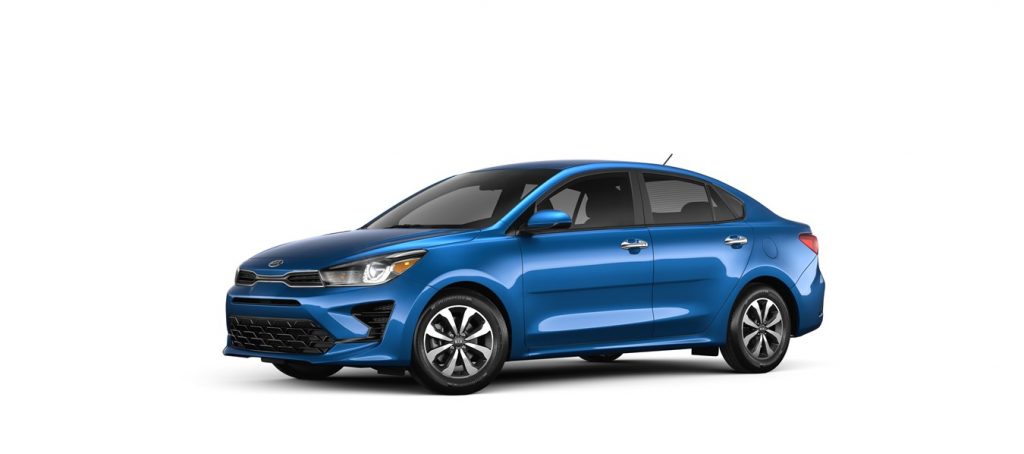
The 2021 Kia Rio is Kia’s subcompact car option

The 2021 Kia Rio might seem like an underwhelming option, but for the price it offers a simplistic and reliable option. While it isn’t ranked particularly high on the Consumer Reports rating, the Kia Rio does offer every trim level at a modest price, and even some luxuries like Apple CarPlay and Android Auto. Of course, it comes with standard options like a mandated backup camera and touchscreen infotainment system, but it keeps driving aids to a minimum for drivers looking for something more basic.

With a modest MSRP of $17,045, the 2021 Kia Rio packs quite a punch even with the base model, which provides the subcompact car with:

  • 8-inch touchscreen infotainment screen
  • Apple CarPlay and Android Auto, along with Bluetooth connectivity
  • Heated mirrors
  • Adjustable steering wheel
A blue 2021 kia rio s
2021 Rio S | Kia

RELATED: The 2021 Kia Rio Missed the Mark According to Consumer Reports

As brand new vehicles, all of these affordable, subcompact cars come with a standard new car warranty, each of which have their own separate restrictions. These simple options are the perfect solution for getting from point A to point B without much worry for how many miles your driving or what condition the car stays in.

The post The Cheapest 2021 Subcompact Cars Offer Affordability and Not Much Else appeared first on MotorBiscuit.

by Gabrielle DeSantis

The Subaru Forester is a well-rounded vehicle that does it all. It is capable of going off-road and getting good fuel economy on the road, too. Consumer Reports called the Subaru Forester the most dependable compact SUV on the market for 2021, and we can see why.

What year is the most reliable Subaru Forester?

The Subaru Forester is recommended by Consumer Reports | Zhe Ji/Getty Images

Consumer Reports lists the reliability history for the Forester for the last few years. Since 2018, the reliability has increased. For the 2021 Forester, the predicted owner satisfaction and predicted reliability both scored a four out of five.

Many safety features that are options on similar vehicles come standard on the Forester. These include forward-collision warning, automatic emergency braking, lane departure warning, and lane-keeping assist. It also has anti-lock brakes, traction control, and a rear-view camera.

The 2020 Forester scored a five out of five for both reliability and owner satisfaction. It also has high scores from the Insurance Institute for Highway Safety (IIHS) and National Highway Traffic Safety Administration (NHTSA). The 2019 model has similar scores if you are in the market for a used vehicle. Depending on your budget, one of the recent years for the Subaru Forester should fit your budget. Look for one with a warranty left, if possible.

What problems do Subaru Foresters have?

Since the 2021 Forester is new, it is hard to diagnose some issues this early. Consumer Reports found the 2.5L four-cylinder was powerful compared to previous years, but it isn’t the fastest SUV around. The 0-60 mph time came in at an unimpressive 9.2 seconds, but it isn’t worth taking the Forester off your list yet.

Owners say that the continuously variable transmission (CVT) works well but is loud under acceleration. It gets an overall 28 mpg, which ties the Honda CR-V EX for fuel economy. That puts it in the number one spot with the CR-V for overall fuel economy.

Consumer Reports says the ride and handling have improved over the 2020 version, noting it handles better than other SUVs in the category. There is less body roll and faster steering response as well.

The Forester still beat the 2021 Mazda CX-5 and the 2021 Honda CR-V by a few points, which makes it the most dependable compact SUV in the segment.

Edmunds agrees with Consumer Reports

Edmunds found that the 2021 Subaru Forester was a reliable choice as well. It has all-wheel-drive standard and comes with many driver-assist features. Edmunds also noted that the better-than-average ground clearance is an additional benefit. Some of the cons noted were the less-than-impressing engine and a low tow rating. This is a limiting factor for the overall utility of the Forester.

Like what Consumer Reports noted, it has many extra features that come standard and some upgraded tech. These make the Forester a good buy for someone looking for a smaller SUV. Edmunds gave it a 7.8 out of 10 overall, with the interior and tech leading the way.

The experts at Edmunds suggest the Premium trim for the panoramic sunroof and alloy wheels. Consumer Reports agrees that the Premium trim is worth the extra cash and suggests the All-Weather package for heated front seats. Priced between $24,795 and $34,895, the Forester is a fun little SUV that will get the job done.

RELATED: Is the 2022 Subaru Outback Wilderness Better Than the Subaru Crosstrek?

The post Is the Subaru Forester Consumer Reports Most Dependable Compact SUV? appeared first on MotorBiscuit.

by Gabrielle DeSantis

Some might remember when it wasn’t uncommon to see a roadside traveler with their thumb out, looking for a ride. Safety concerns, particularly among Westerners, greatly reduced the number of hitchhikers on U.S. roads. But hitchhiking remains a popular travel method in other parts of the world.

Can you still legally hitchhike in the United States and, if so, where? If you end up hitchhiking, how can you do it safely? We’ve got the answers.

The dangers of hitchhiking

When hitchhiking, you’re always risking your safety by getting into a stranger’s vehicle. The person offering you a ride might be a good citizen and will get you a little farther on your travels. Bonus points if you find one who’s also a decent conversationalist.

But if the person who stops on the side of the road has poor intentions, it’s important to know the warning signs, Art of Manliness explains. Here are some red flags.

Before getting in, quickly glance over the person’s vehicle. If it’s dirty inside and out, smells foul, and is littered with trash, you might be dealing with a person with misplaced priorities. Best-case scenario, they’re like your super-messy college roommate. Worst-case scenario, they care as little about safety as they do hygiene.  

If you see empty alcohol containers or drug paraphernalia scattered inside, you should probably turn down that ride.

Also, pay attention to the person offering you the ride. Do they avoid eye contact with you? Is there too much eye contact? If something seems off, they might have something to hide. 

If there’s more than one person in the vehicle, you’ll want to be careful. That’s because if they have bad intentions, you’re already outnumbered.

The driver’s mood is another consideration. If they seem angry, controlling, or impatient, you might want to turn down the ride. Best-case scenario, the entire ride will be uncomfortable. Worst-case scenario, the person could pose a threat.

Last, even if you see none of those warning signs but your gut still tells you something is amiss, walk away.

Where is hitchhiking illegal?

According to the New York Times, hitchhiking on limited-access highways is illegal in all U.S. states except Arkansas, Kentucky, Missouri, North Carolina, and South Carolina. If you stay off the pavement on secondary roads, hitchhiking is generally allowed in all states except Hawaii, Nevada, New Jersey, North Dakota, and Wyoming.

Many hitchhikers find the police and local authorities helpful. In New Brunswick, New Jersey, where Douglas College and Rutgers University students frequently hitchhike, local police often offer them safe rides. After over 50 interviews with hitchhikers, the Times team learned police officers were allies who often offered safe, free rides.

How to hitch a ride safely

Though there are more horror stories about hitchhiking than tales of good experiences, you can do several things to keep yourself safe if you end up giving it a try.

Experienced hitchhiker Matt Karsten told Nomadic Matt that in his own experience, he has encountered “weirdos,” but he rarely encounters dangerous situations. He explained that on a recent adventure, out of 36 rides, he encountered two or three socially awkward drivers.

When hitchhiking, be prepared for any situation because there’s still risk involved. Take a photo of any car you get into, make sure the license plates are clearly visible, and send that image to a trusted friend or family member before you get in.

If you feel uncomfortable or threatened once you’re in someone’s vehicle, ask the driver to stop and let you out at the next public area or exit. Invent an excuse if that would make it easier. If the driver refuses to stop, remind them about the photo of their vehicle and plates you sent to others. 

Karsten added that you could grab the steering wheel or emergency brake to cause a minor accident if you truly feel you’re in danger. However, even minor car accidents can still kill or seriously injure occupants and other motorists.

RELATED: Why Do People Ride Motorcycles When It’s So Dangerous?

The post Can You Safely Hitchhike? appeared first on MotorBiscuit.

by Gabrielle DeSantis

Tesla has been quietly raising prices on the Model 3 and Model Y behind the scenes. Why are prices increasing? Elon Musk says the brand has been hit by raw material prices increasing, much like the rest of the industry.

Is the Tesla Model 3 going to get cheaper?

The price of the Tesla Model 3 and Model Y is increasing again | Zhe Ji/Getty Images

As reported by Electrek, electric vehicles are likely not going to go down in price anytime soon. Like most industries, Tesla is not immune to price increases across the board. With the supply chain issues impacting the industry and the semiconductor chip drama, it isn’t a surprise the price has gone up. What is a surprise, though, is how Tesla seems to be raising prices.

It seemed arbitrary at first glance, and perhaps it is. The Model 3 and Model Y have increased seven times in the past few months. Each time it was just a bit. $500 here and another $500 a few weeks later. Eventually, it all starts to add up.

Back in February, the Model 3 Standard Range Plus price increased from $37,000 to $40,000. That’s more than 8%. The Model Y Long Range AWD was under $50,000 but is now starting at $52,000.

So far, it does not seem that any of the Tesla models are going to get cheaper. If the supply-chain issues persist, the cost of the vehicles will likely increase before decreasing.

Did the Tesla Model Y price go up?

Elon Musk responded on Twitter when someone commented about removing lumbar support in the Model Y seats. Musk responded that prices are increasing due to “major supply chain price pressure industry-wide” and that raw materials were a large part of that.

Electrek noted that the price of copper has doubled since the pandemic started, and other materials like steel and aluminum have also increased. Some drivers have speculated that removing lumbar support is a way of cutting costs in a roundabout way. It isn’t a major point of functionality, but what will the brand remove next to save some cash? Will prices continue to increase while parts continue to get removed?

The issue seems to be that buyers placed an order for a car with certain features, and the cars are being delivered without said features. How many will more things be removed to continue to fulfill orders? Buyers were unaware of the lumbar support being removed before delivery, which has only added to the backlash.

If nothing else, the situation is confusing for those about to take delivery of a new Tesla. Will buyers get the car ordered, or one without lumbar support? Will radar be included?

Consumer Reports and IIHS are reeling from changes

Last week, there seemed to be some misunderstanding between Tesla, Consumer Reports, the IIHS, and NHTSA. While Tesla vehicles were being delivered without radar, it was widely reported that the Insurance Institute for Highway Safety (IIHS) and National Highway Traffic Safety Administration (NHTSA) were dropping awards given to the Model 3.

It seems that is not the case as it stands right now, but the IIHS and NHTSA will likely do testing on the vehicles soon. Electrek contacted Elon Musk directly to confirm the issue.

“Just confirmed with the Autopilot team that these features are active in all cars now, including vision-only. NHTSA automatically removes the check mark for any cars with new hardware until they retest, which is happening next week, but the functionality is actually there.”

Elon Musk | Electrek

The report went on to say that some owners took delivery of the Model 3 and Model Y over the weekend, and these features were active. The NHTSA and IIHS will likely be testing the new cars in the upcoming weeks, at which time we will know more. It does sound like the safety features are active at this point.

RELATED: Edmunds Recommends the Porsche Taycan Over the Tesla Model S

The post Why Is the Price of the Tesla Model 3 and Model Y Increasing Again? appeared first on MotorBiscuit.