
by Gabrielle DeSantis

Police Vehicles Parked Side By Side | (Photo by Alexi Rosenfeld/Getty Images)

Ah, one of Americans’ favorite hobbies, telling people from other states they have the worst drivers. Whether it’s because you commute to another state or just have a hunch, everyone has their own idea of which state has the worst drivers. Data scientists at Insurify took a deep dive into what makes a driver bad, and where those people are mostly located.

What makes someone a bad driver?
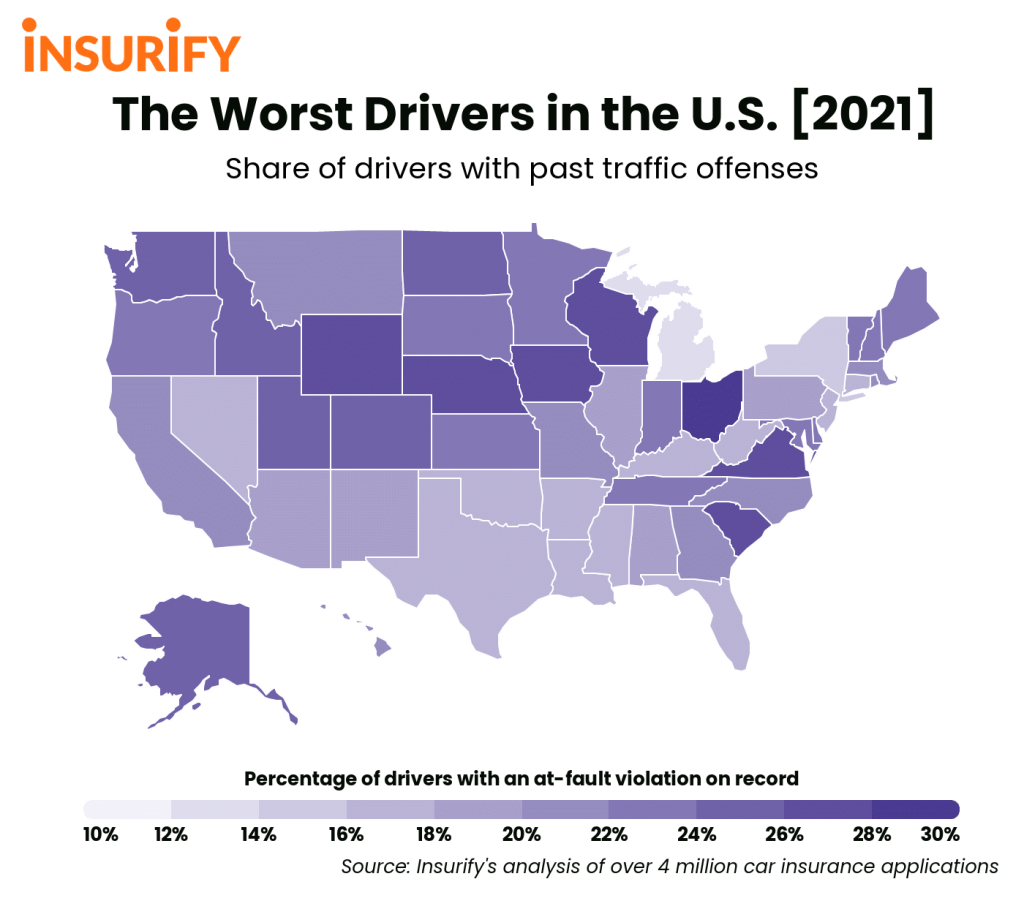
The most traffic incidents in the US by state map
Most Traffic Incidents by State | Insurify

There are plenty of ways someone can be defined as a bad driver. For most people, it’s because they cut you off or didn’t yield when they should have. The metrics used to determine bad driving by Insurify, however, are more concrete and provable.

Firstly, the number of drives with an at-fault violation on their record. This means they’ve been in an incident where it was considered their fault, and that is displayed on the driver’s current driving record. This includes people who have been involved in accidents, DUIs, failures to stop, speeding, reckless driving, passing violations, and other citations for illegal driving. Insurify then compared these numbers from each state to the total number of drivers applying for car insurance.

National Averages
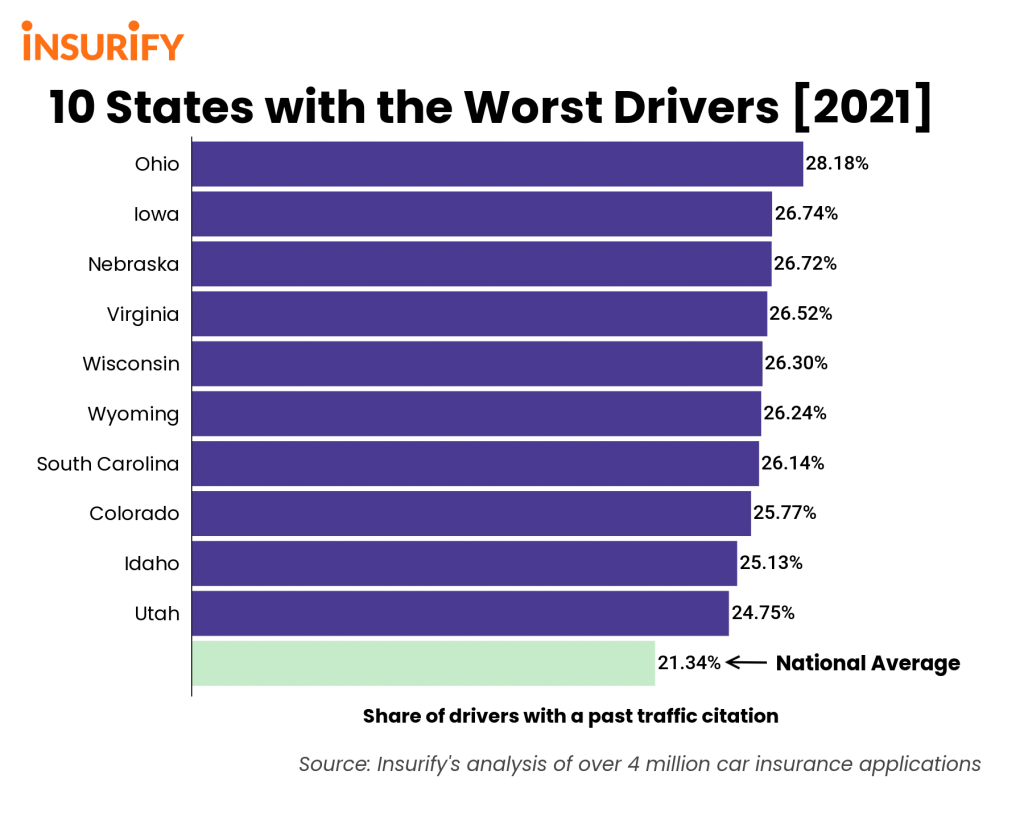
Top 10 States with the most traffic incidents in 2021
Most Traffic Incidents Bar Graph | Insurify

According to Insurify, the average share of drivers reporting a prior traffic incident is 21.34 percent. In 2019, the average number of traffic fatalities per 100,000 population in the U.S. was 11. Therefore, if any of the states are exceeding that national average regularly, they’ll likely be considered a state with bad drivers.

10. Utah

  • Share of drivers reporting a prior incident: 24.75%
  • Traffic fatalities per 100,000 population: 7.7 deaths

Though tenth isn’t quite enough for someone to say Utah has the worst drivers in the country, there are 40 other states that can say Utah is worse than them. Utahn drivers are cited for illegal behavior while driving 14 percent more than the national average.

9. Idaho

  • Share of drivers reporting a prior incident: 25.13%
  • Traffic fatalities per 100,000 population: 12.5 deaths

The incident rate for Idaho has actually decreased from 27.7 to 25.13 since 2019, but it’s still enough ahead of the national average to land Idaho drivers ninth place on the worst drivers list. Not to mention they’ve averaged 4.8 more deaths per 100,000 people than tenth place Utah.

8. Colorado

  • Share of drivers reporting a prior incident: 25.77%
  • Traffic fatalities per 100,000 population: 10.3 deaths

While Idaho tends to have more fatal incidents than Colorado, Colorado’s overall number of incidents remains higher. Could dangerous driving have any correlation with the high altitude?

7. South Carolina

  • Share of drivers reporting a prior incident: 26.14%
  • Traffic fatalities per 100,000 population: 19.4 deaths

With a number of incidents coming in just above the previously mentioned Colorado, we can’t say the same for fatalities. South Carolina nearly doubles Colorado’s traffic fatalities per 100,000 people. South Carolina actually ranks fourth in the country for traffic-related deaths per capita, according to Insurify.

6. Wyoming

  • Share of drivers reporting a prior incident: 26.24%
  • Traffic fatalities per 100,000 population: 25.4 deaths

Reported driving incidents continue to slowly climb up as the list continues, while fatalities continue to take leaps. Wyoming drivers have the second-highest DUI rate in the country, which surely results in a high number of fatalities. Wyoming’s traffic fatalities per 100,000 population are the highest in the country, at 57 percent higher than the national average.

5. Wisconsin

  • Share of drivers reporting a prior incident: 26.30%
  • Traffic fatalities per 100,000 population: 9.7 deaths

Wyoming has been known to appear on the top ten rankings for DUIs and rudest drivers in 2021. Which inevitably leads to their large number of reported incidents. Though Wisconsin averages more total incidents than Wyoming, they average just a fraction of the fatalities per 100,000 people.

4. Virginia

  • Share of drivers reporting a prior incident: 26.52%
  • Traffic fatalities per 100,000 population: 9.7 deaths

Virginia ranked first as having the rudest drivers in the country for 2021 according to Insurify, so it’s no surprise they land this high on the list. A whopping 20-percent higher than the national average overall driving incident rate, fatalities being lower than the national average help keep Virginia from ranking even higher.

3. Nebraska

  • Share of drivers reporting a prior incident: 26.72%
  • Traffic fatalities per 100,000 population: 12.8 deaths

While the prior incident reporting continues its upward trend with our list, the traffic fatalities had actually declined quite a bit from national leader Wyoming. That number jumps back above the national average with Nebraska. Insurify says its data suggest Nebraskan drivers are on the negligent side, resulting in these high numbers.

2. Iowa

  • Share of drivers reporting a prior incident: 26.74%
  • Traffic fatalities per 100,000 population: 10.6 deaths

Iowa drops back below the national average for traffic fatalities per 100,000 population with just 10.6 but has even more incidents. Only 0.02% more incidents than Nebraska, drivers in Iowa get themselves citations 21 percent more frequently than the national average.

1.  Ohio

  • Share of drivers reporting a prior incident: 28.18%
  • Traffic fatalities per 100,000 population: 9.9 deaths

If you made it all the way to the end of this list, you were probably expecting to see your home state or maybe a neighboring one. If either of those is Ohio, you’d be right. This is it, the worst drivers in the country are from the Buckeye State. Topping out the list with the highest reported prior incidents, Ohioans may need to let off the gas pedal a bit. They are number one on a few lists other than this one, including most speeding tickets per capita, and overall citations received. Though Ohio comes in just below the national average for traffic fatalities,  their dangerous driving habits landed them the top spot on the list for states with the worst drivers in America.

If you saw your home state on this list, you might be thinking “I was right!”. If you didn’t see your home state or any surrounding states on this list, maybe you’ll rethink your route the next time you take a cross-country road trip.

RELATED: 10 of the Best and Worst States for Teen Drivers

The post Top 10 States With the Worst Drivers appeared first on MotorBiscuit.

by Gabrielle DeSantis

Buying a used car is a great way to get a high-quality vehicle at a reasonable price. Many models can run for decades without major problems, and shoppers who opt for used cars can usually get their money’s worth in a few years. Unfortunately, not all models make good used cars. That includes the 2011 to 2014 Volvo XC70 T6 wagon.

Learn more about why you should avoid purchasing one of those models and what Consumer Reports suggest as a better alternative. 

Consumer Reports’ list of used ‘oil burner’ cars

2014 Volvo XC70 | Volvo Car Corporation

Although it’s common for vehicles to burn oil once their engine reaches 10 years old or more, some models are notorious for burning excessive oil no matter the mileage. 

This is highly problematic for owners of those cars because many vehicles on the list are old enough to have an invalid warranty, and addressing the problem can be expensive. You should purchase one of these vehicles only if official documentation states that repairs have been made and the issue is fixed. 

Notable vehicles on the Consumer Reports list “Used Cars That Burn Oil—And What to Buy Instead” include the 2010 to 2013 Acura MDX, the 2010 to 2012 Audi S4, and the 2012 to 2019 BMW M5. Despite Subaru’s reputation for building reliable vehicles, several of the brand’s models appear on the list, including the 2010 to 2015 Legacy, Forester, and Outback and the 2010 to 2014 Tribeca. 

These Volvo wagons are also plagued by excessive oil consumption

Another interesting inclusion on Consumer Reports’ list is the 2011 to 2014 Volvo XC70 T6, a wagon popular throughout those model years. CR found that the models with a 3.0-liter turbocharged six-cylinder engine burn oil, making them less-than-ideal used cars. 

At the same time, this wagon has a lot going for it. Consumer Reports highlights its extensive standard safety features and smooth ride. In addition, U.S. News calls the interior and exterior attractive and sleek, and the XC70 provides plenty of cargo space for individuals and families who plan to haul plenty of gear. 

U.S. News gave the XC70 T6 a 7.6 out of 10 overall. Its handling, performance, and gas mileage (18 mpg in the city and 26 mpg on the highway) didn’t impress reviewers. The site also mentioned that the wagon’s dashboard controls were unintuitive and confusing, which knocked off a point or two. 

If you have your heart set on a used wagon and you like the looks and features of the Volvo XC70 T6 from this era, CR recommends you consider a 2014 Toyota Venza instead. The current price for a 2014 Venza is between $14,000 and $19,000, and it scores high for reliability. CR rates the V6 engine as surprisingly powerful and deems the Venza a practical crossover SUV with plenty of cargo space. 

U.S. News praises the 2014 Venza for its smooth ride and roomy back seats and named it the #1 Affordable Midsize SUV of 2014. The Venza earned an overall score of 8.5 from U.S. News, receiving a few points off for low-quality cabin materials and lackluster handling. 

Overall, the 2014 Toyota Venza is a reliable and safe, albeit uninspiring, ride. But it would make a great choice for individuals or families who want a wagon-like crossover SUV at a great price. 

RELATED: The 2021 Volvo XC40 Recharge Might Confuse You When You Try to Start It

The post Never Buy These Used Volvo ‘Oil Burner’ Wagons, According to Consumer Reports appeared first on MotorBiscuit.

by Gabrielle DeSantis

If you’re after a used sports car, but still have a family to carry around and look after or need some extra space, there are plenty of inexpensive choices out there. Sports sedans are just performance cars with four doors, so it’s far from impossible to find a car that goes fast and also has a back seat. All of these cars have proven performance records, are rear-wheel-drive and can come with a manual transmission. Some may be a little on the older side, but they are all reliable enough to last a long time.

2007 BMW 335i: turbocharged horsepower

At this point it’s fairly old, but the 2007 E90 335i is still an excellent sports sedan. At the time it used a twin-turbocharged 3.0-liter inline-six that made 300 horsepower. It could be paired with a manual transmission, and though it didn’t have a mechanical limited-slip differential, it used computers to regulate traction much like an LSD would, which BMW called an electronic differential. While many trivial things on the car might break, like the little arms that deliver the seatbelts, the engine and transmission are solid.

2018 Honda Civic Si: the complete package

Honda Civic Si | Honda

Honda’s Civic Si has it all. It’s got a manual transmission, 205 horsepower, and weighs less than 3,000 pounds. It’s front-wheel-drive, but for all intents and purposes the car handles beautifully and is well balanced. The interior is borderline luxurious, with smooth leather and a snug cockpit for the driver. Passengers have plenty of room to stretch out, even in the back seat, and the trunk is big enough for a long trip, which is more than possible considering the car’s excellent gas mileage.

2014 Mitsubishi Lancer Evolution GSR: agile and modern

2015 mitsubishi lancer evolution x
2015 Lancer Evolution Final Edition | Mitsubishi

Although it’s a slight departure from its ancestors, the Mitsubishi Lancer Evolution X is nevertheless a proper sports sedan. The GSR uses a 2.0-liter turbocharged inline-four only mounted to a 5-speed manual transmission, and sends 291 horsepower to all four wheels. This car hits the limit of $30,000, but is worth every penny. Its big discrepancy comes from its all-aluminum engine, which contradicts the iron-block 4G63T from previous Evo generations. The old block could hold a lot of boost and could go all day, but the new engine is no slouch. Without mods the Evo X will last a while.

2008 Infiniti G37: affordable luxury

2009 infiniti g37 sedan
2009 Infiniti Full Line Event Napa, CA | Infiniti

A distant relative to the Nissan GTR, the Infiniti G37 slots into the luxury sports sedan category. It uses a 3.5-liter V6 pushing 305 horsepower to the rear wheels, via a six-speed manual transmission, all this to move 3,628 pounds. It’s not light, but it handles well enough and has serious getup-and-go. Opting for the Sport package nets a limited-slip differential and 19-inch wheels.

While these are some of the best options, there are plenty more available on various online marketplaces. Comparatively, $30,000 is a sizable budget as long as used cars aren’t off the table. Prospective owners could even get away with much less money for a sports sedan. 

RELATED: Top 3 Best Used Sports Cars Under $20,000

The post The Best Used Sports Sedans Under $30,000 appeared first on MotorBiscuit.

by Gabrielle DeSantis

Tesla has dominated the EV market for years, but many other automakers have begun producing electric vehicles to compete with Elon Musk’s juggernaut. SUVs make up the most popular vehicle segment in America, so it’s no surprise many car manufacturers are making electric SUVs. Here’s a look at what might be the best electric SUV on the market right now.

EVs have gone mainstream

The Ford Mustang Mach-E electric SUV and Ford Explorer hybrid at AutoMobility LA in November 2019 | David McNew/Getty Images

Technically speaking, some of the first production EVs were made by major automakers. However, they failed to gain much traction, and EVs only began becoming more popular in recent years thanks to Tesla. Now, due to EVs’ increasing popularity, major automakers are jumping back into the EV game.

Manufacturers are making EVs in almost every segment and at different price points. For example, affordable models include the Mini Cooper SE and high-performance cars like the all-electric Porsche Taycan. But one of the fastest-growing EV segments is SUVs.

Americans want SUVs, whether they’re gas-powered or electric. So there’s no shortage of electric SUVs on the market. Interestingly, though, the two best electric SUVs right now are at different price points.

The Ford Mustang Mach-E is arguably the best electric SUV right now

According to Road Show, the best electric SUV right now is the Ford Mustang Mach-E. This isn’t a huge surprise because the Mustang Mach-E has been winning many awards lately. The reason the Mach-E won is fairly simple, too. It lives up to what SUV customers want in an SUV. The Mach-E is not only sporty but also functional.

For example, the standard model can go from 0 to 60 mph in 5.8 seconds with its 266-hp electric motors. At the same time, the standard trim provides a decent range of about 230 miles on a single charge. Plus, it has a good amount of cargo capacity. It has 29 cubic feet of cargo space without the rear seats folded. The standard Mach-E is also fairly affordable, starting at about $43,000. 

However, Ford offers quite a few options. Many customers will probably choose to upgrade their Mach-E’s range and electric motor. At best, the Mach-E gets 300 miles of range or a much more powerful motor.

But regardless of what customers choose, the Mustang Mach-E is still more affordable than the runner-up among electric SUVs, the Audi e-tron.

The Audi e-tron is a close 2nd to the Ford Mustang Mach-E

According to Road Show, the Audi e-tron is a deceptively good car. This is mainly because its specs aren’t that spectacular. At a full charge, the e-tron is supposed to get about 222 miles of range. That’s not much range, and it puts the e-tron at a disadvantage compared to many rivals. However, what makes the Audi e-tron a good electric SUV is that, despite its range, it provides plenty of fun.

The e-tron’s twin electric motors generate about 355 hp or over 400 hp with a boost. Plus, because it’s a luxury vehicle, it has a beautiful, comfortable interior.

But it’s also somewhat practical, Road Show says. It has all-wheel drive as standard, and it offers over 28 cubic feet of cargo space without the seats folded down.

However, the Audi e-tron, being a luxury SUV, start at about $67,000. And that high price makes this electric SUV unattainable for many consumers.

Fortunately, the Ford Mustang Mach-E fills that gap.

RELATED: Tesla Fell to Ford for 2021 EV of the Year, but Don’t Get Too Upset

The post What Is the Best SUV on the EV Market? appeared first on MotorBiscuit.