Ford’s Multi-Million Dollar Driving Simulator | Virtual Vehicle Development, Tested and Explained
This video was first publish on Javier Mota Youtube Chanel
https://www.youtube.com/v/dTy-TWY8Z2s?version=3? Location: Ford Driving Dynamics Lab, Dearborn, Michigan
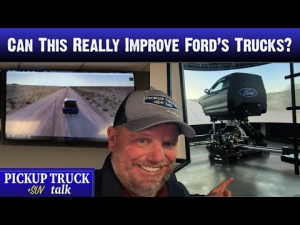
Step inside Ford Motor Company’s state-of-the-art Driving Dynamics Lab at its Dearborn, Michigan World Headquarters, home to one of the most advanced multi-million dollar vehicle simulators in the automotive industry.
In this video, we go behind the wheel of Ford’s Dynamic Simulator, powered by VI-grade’s Driver-in-the-Loop (DiL) technology, to see how engineers virtually develop, test, and refine vehicle ride, handling, ADAS, and autonomous driving systems long before a physical prototype ever hits the road.
This high-fidelity simulator uses a large-motion platform capable of replicating real-world lateral, longitudinal, and yaw forces, allowing Ford engineers to experience realistic driving behavior while tuning vehicle dynamics in a fully virtual environment. The result: faster development cycles, lower costs, improved safety, and higher vehicle quality.
By connecting analytical simulations with real-world testing, Ford can bring vehicles to market more efficiently while incorporating customer feedback earlier in the development process—a critical advantage in today’s rapidly evolving automotive landscape.
In this video, you’ll learn:
How Ford uses virtual development to replace and reduce physical prototypes
Why simulators are critical for ADAS and autonomous vehicle testing
How VI-grade’s DiM motion platform replicates real driving forces
How Ford accelerates innovation while improving safety and quality
? Technology Partner: VI-grade
Technical Specifications (Simulator Overview)
Simulator Type: Driver-in-the-Loop (DiL) Dynamic Simulator
Motion Platform: VI-grade DiM series (large-motion system)
Degrees of Freedom:
Longitudinal acceleration
Lateral acceleration
Yaw rotation
Primary Applications:
Ride and handling development
Advanced Driver-Assistance Systems (ADAS) tuning
Autonomous vehicle behavior validation
Development Benefits:
Reduced physical prototypes
Lower development costs
Shorter time-to-market
Enhanced safety validation
Improved vehicle quality
Integration:
Analytical simulations
Virtual testing environments
Physical vehicle development pipeline
#Ford
#FordMotorCompany
#DrivingSimulator
#VehicleDevelopment
#AutomotiveEngineering
#ADAS
#AutonomousVehicles
#VirtualTesting
#VIgrade
#CarTechnology
#FutureOfDriving
#DearbornMichigan
#EngineeringInnovation
#AutomotiveTech
#BehindTheScenes