by Gabrielle DeSantis

Policing has been a hot-button issue in America for many years – maybe forever. However, after the murder of George Floyd in the summer of 2020, more Americans’ eyes were open to the long-standing conversation around unfair and predatory policing. Although we know there are undercover police, these new Texas police cars, or ‘ghost’ Chevy Camaros, are ramping up the predatory and downright eerie aspects of modern policing in America. 

“Ghost” Camaro | Harris County Sheriff’s Department

Are these ‘ghost’ Camaros actually helpful? 

Texas Police have just started implementing what they are calling ‘Ghost’ Camaros. These are white Chevy Camaros with white police markings. Although seeing the police markings is nearly impossible, especially at speed, these are technically not unmarked cars. 

According to The Drive, the Harris County Sheriff’s Department will be the ones sneaking around in these phantom cop cars. This will undoubtedly help the police fine more speeders, but will it actually make people obey the speed limit? 

On top of the camo police decals, the lighting and siren mechanisms are also hidden so these Texas police ghost Camaros can stay in the shadows. 

Are traffic police helping or just raising money? 

Texas police Camaro following a car on the highway
Texas police ghost car | @bruceallmighty Twitter

It is a known fact that well-marked police cars are one of the best ways to deter people from speeding. This is such a known thing that many police departments will often park empty cars on the side of the road to get people to slow down. This works. 

How then can unmarked or ghost cars prevent speeding? Well, it seems they don’t, really. The main goal seems to be only to catch speeders and fine them instead of actually stopping speeding. The Drive goes on to suggest that these unmarked or lightly marked police cars do nothing to make our communities safer. Instead, they serve only to make money. 

The other side of undercover or ghost police cars is to breed the fear into drivers that the police can be anywhere whether we see them or not. The argument is this constant fear will keep speeds down. But as most things in our lives prove, the unseen, forgettable fears are often, well, easier to forget. Not to mention the anxiety and mental stress this aims to impart on innocent citizens.

The other argument against these types of secret police cars is that these cars can confuse drivers. The difference between a decommissioned police car and an unmarked cruiser can be quite narrow in some cases. If police cars had to be clearly marked, there would be far fewer instances of people impersonating police. 

Unmarked or ghost police cars do have some value though

In some counties, unmarked police cars are used only to gather intel on wanted or suspected criminal operations. This makes perfect sense for the same reason clearly marked cop cars help deter speeding. Interestingly, this same simple logic isn’t applied across the board in American policing. The narrow value of unmarked police cars is undeniable. The general idea that police should roll around more incognito feels naive at best and maybe downright dishonest. 

The police are meant to be a community resource. This department was created to “protect and serve,” meanwhile, the deeper we look into policing as a whole, in this country, we see a trend of increased aggression, opposition, and fear-mongering, instead of trust, respect, and servitude. The more forthright policing can be, the more effective it is in gaining the trust and cooperation from the community it is meant to serve. 

Pulling stunts like these stealth cars goes against everything the police are meant to represent in our society. So, keep your eyes peeled for ghost police cars, and never hesitate to call the police or another trusted official if you are worried about being pulled over by an unmarked car.

RELATED: This Proves the NYPD Really Does Love Donuts

The post Keep Your Eyes Peeled For The Texas Police ‘Ghost’ Camaros appeared first on MotorBiscuit.

by Gabrielle DeSantis

Tesla CEO Elon Musk has made a playful and colorful statement about the Model S Plaid. Musk says the car’s machine learning systems are so intuitive that it almost feels like telepathy. So will drivers comfortably adapt to their car predicting their every move, or is it enough to evoke the chills of the uncanny valley?

Can the Tesla Model S Plaid read your thoughts?

Tesla Model S Plaid | Tesla

Elon Musk is known for attention-getting statements. During the official live stream reveal of the Model S Plaid, he offered a quote no one will soon forget. The Tesla founder was discussing the Model S Plaid’s advanced features when he made his whimsical comment.

As owners drive their Model S Plaid, the car begins to learn certain patterns, locations, and behaviors. This allows the car to make decisions based on learned behavior preemptively. Examples of how this could work include learning a favored route or at which angle to back out of a familiar location.

While it may not be telepathy, this system is fascinating. This application is a perfect example of how machine learning can make everyday life safer and easier. It’s another step closer to truly autonomous production cars.

Beyond autopilot and parking assit

Artificial Intelligence will only increase its presence in everyday life. Tesla’s AI systems could be applied to a nearly limitless number of applications. Beyond just learning a driver’s route to work, AI could be programmed to control any aspect of a vehicle.

Cars could respond to changes in weather in real-time. Automatic climate control that responds to changes in ambient temperature is easily achieved with machine learning. Adjusting the headlights, turning on windshield wipers, or defrosting the windshield could all become tasks cars perform for themselves.

Tesla’s Full Self Driving mode demonstrates how many processes a car’s AI system can process. FSD has been scrutinized by many, including skeptics and the state government of California. Many feel the technology is fundamentally unsafe. Elon Musk has been accused of exaggerating its readiness.

Elon Musk’s colorful expression is a sign of his passion for engineering

Tesla CEO Elon Musk making a double thumbs up gesture
Elon Musk | Britta Pedersen-Pool via Getty Images

A common theme in Elon Musk’s statements and interview responses is the influence of science fiction on his work. This influence is overt in projects like SpaceX or the Cybertruck. The passionate CEO is often visibly animated when talking about the development of his products.

Science fiction blurs the lines between the practical and the mystical. The genre appeals to many lovers of science because of this flattering comparison. For them, science is already as exciting as the supernatural. Tesla’s CEO is, above all else, an enthusiast for advancement and innovation.

Musk’s frequent use of colorful and illustrative expression stems from this dedication and passion for science. While some may criticize his style of expression, others see an impassioned creator. Whichever camp one falls in, Elon Musk and Tesla’s incredible advancements to bring machine learning to everyday driving cannot be denied.

The mainstream adoption of self-driving cars is inevitable, but the timeline is somewhat fuzzy. Machine learning is already omnipresent. The question is, when will people accept cars that think for themselves?

RELATED: Can the Tesla Model S Plaid Really Get to 60 MPH in Less Than 2 …

The post Can The Tesla Model S Plaid Read Your Mind? appeared first on MotorBiscuit.

by Gabrielle DeSantis

The 2019 Volkswagen Jetta has received plenty of criticism. It makes a horrible grinding sound that many owners began hearing when the car reached around 10,000 miles. And it earned an abysmal 57/100 overall rating from Consumer Reports, largely attributed to lackluster driving dynamics. But an annoying sound and a boring ride are small potatoes compared to the 2019 Volkswagen Jetta’s dangerous engine problems.

What is the 2019 Volkswagen Jetta’s hazardous engine issue?

According to many complaints owners reported to the NHTSA, the 2019 Volkswagen Jetta‘s engine stalls without warning, typically when slowing to a stop or turning a corner. But there have been reports of it stalling at speeds around 20 mph. Suddenly coming to a stop is dangerous, particularly because the Jetta’s brake lights wouldn’t give drivers following any warning the car was stopping. And stalling on the freeway, even in stop-and-go traffic, can be even more dangerous, particularly if you can’t get the car restarted right away.

CarComplaints.com compiles complaints from the NHTSA and driver complaints posted on its own site. It also provides a severity rating, the average mileage at which the problem happens, and whether the issue has caused any crashes, fires, injuries, or deaths.

The 2019 Jetta’s engine problem received a 10 for severity, pretty much the worst rating. CarComplaints.com appropriately classifies the issue as “really awful.” Also, the problem usually occurs around 4,444 miles. There have been two crashes, one fire, and three injuries. Thankfully, no deaths have been reported.

How owners are highlighting the severity of the problem

There are many complaints about the engine problem, 427 to be exact. Some comments talk about the previously mentioned grinding noise, jerking and shaking with acceleration, and leaking oil and coolant. But the comments about the stalling in particular really illustrate how dangerous the 2019 Volkswagen Jetta’s problem is and how scary it is for drivers.

One owner from Athens, Texas, wrote, “Under low acceleration, it stalls and makes a grinding, whirring sound below 20-30 mph. It makes me timid to drive it because it has almost caused people to rear-end me due to the stall. It falls on its face when you need it to move. I’m concerned as the noise has gotten louder the last few months.”

One of the scarier comments came from an owner in Las Vegas. Their Jetta “began stalling after 6 months of ownership. Car was purchased brand-new with 62 miles. Brought vehicle to dealer 09/27/2019, and they stated it was fine — no issues could be found. On 05/18/2020, the car stalled again — it had 15452 miles on it. It was towed to the dealer, where they kept the car until 07/25/2020 to fix the problem. They stated it was fixed,” the owner wrote.

“On 07/30/2020, the vehicle stalled again, and this time the brakes failed and the steering wheel locked, and I lost control and crashed into a center median with large boulders in it,” the owner continued. “If they were not there, I would have continued into oncoming traffic. I was traveling at 45 mph when the impact occurred. The vehicle safety systems did not deploy because the car’s engine was not running at the time of impact.”

Overview of the 2019 Volkswagen Jetta

The 2019 Volkswagen Jetta has a 1.4-liter turbo engine producing 147 hp, with either an eight-speed automatic or a six-speed manual transmission. It’s worth noting the stalling appears to occur only in Jetta models with a manual transmission.

The base trim has a 6.5-inch touchscreen, and Android Auto and Apple CarPlay are standard. It also received a five-star overall safety rating. However, many driver-assist safety features, such as forward collision warning, are not standard on the base model.

If you have a 2019 Volkswagen Jetta with a manual transmission and you haven’t already had the software update as recommended by VW, contact your dealership right away. And if you’re looking to purchase a used 2019 Jetta, you might decide to check out a car with better reliability and less annoying and dangerous problems.

RELATED: The Worst Volkswagen Jetta Problems Owners Complain About the Most

The post The 2019 Volkswagen Jetta Has Some Brutally Dangerous Engine Problems appeared first on MotorBiscuit.

by Gabrielle DeSantis

It’s common knowledge that the market values of air-cooled Porsche 911s are rather high these days. And that’s even for non-restomodded examples. However, not every air-cooled 911 is priced into the stratosphere; a few bargains remain. And this week on Bring a Trailer, there’s an opportunity to buy one: a 1975 Porsche 911 S.

The ‘impact bumper’ Porsche 911 S was the more powerful sequel to the first-gen car

1974 Porsche 911 S rear 3/4 | Porsche

Although the 964-gen Porsche 911 gave the rear-engine sports car “its first comprehensive update,” it wasn’t the second-gen model, Road & Track explains. Between the 964’s launch for 1989 and the end of first-gen 911 production in 1973, Porsche introduced the second-gen car.

Available from 1974-1989, the 911s from this generation are often called ‘G Model’, ‘G-Series,’ or ‘impact bumper’ models. That last name comes from the impact-absorbing bumpers installed to meet contemporary US crash standards. These 911s also have shorter hoods than earlier models, hence why the latter are sometimes called ‘longhood’ cars.

Under the skin, the impact bumper Porsche 911s are largely the same as their predecessors, R&T says. But that doesn’t mean the second-gen cars didn’t have any updates. For one, this era of air-cooled Porsche 911 gave birth to the first 911 Turbo. And while emissions regulations robbed US-spec cars’ performance, the G-Series 911 got a new, larger fuel-injected 2.7-liter flat-six engine.

However, G-Series customers who wanted some extra performance did have a solution: the Porsche 911 S. Positioned right below the 911 Carrera, the 911 S’s engine makes 175 hp, rather than 150 hp like the base car. While that doesn’t make it fast per se, an impact bumper air-cooled Porsche 911 S is still a vintage 911. And even Jay Leno admits it can be difficult to make an air-cooled engine more powerful.

The 1975 Porsche 911 S on Bring a Trailer

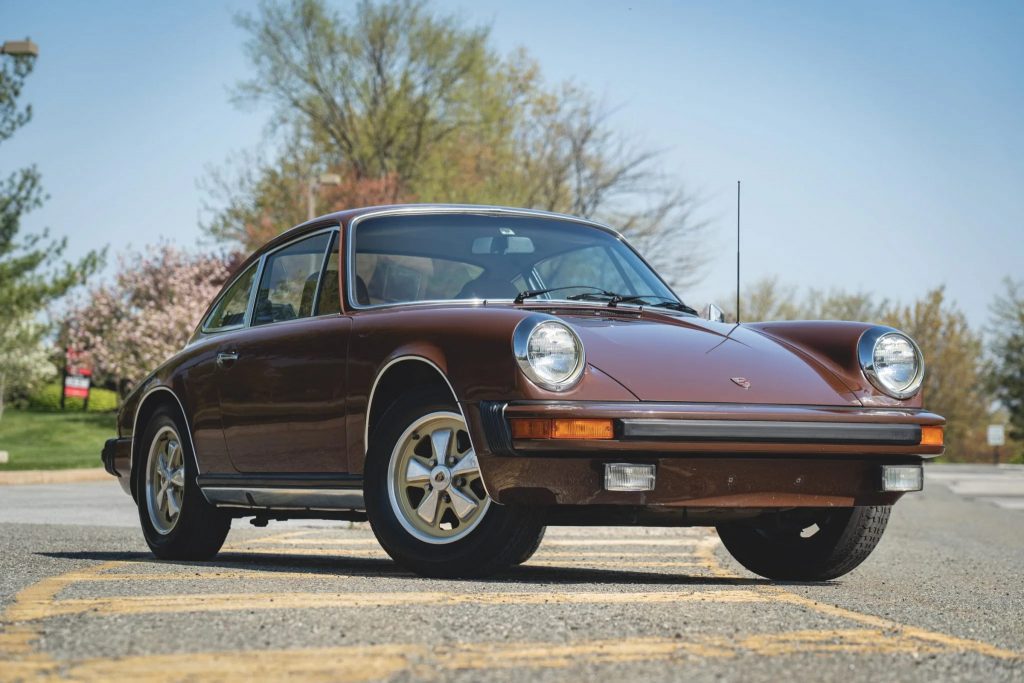
The front 3/4 view of a brown 1975 Porsche 911 S in a parking lot
1975 Porsche 911 S front 3/4 | Bring a Trailer

The 1975 Porsche 911 S currently listed on Bring a Trailer sold on the auction site in February 2019. Since then, the car’s seen some notable service, though it was also extensively serviced earlier in its life. As a result, although the left door is refinished, this 911 S is in excellent condition overall.

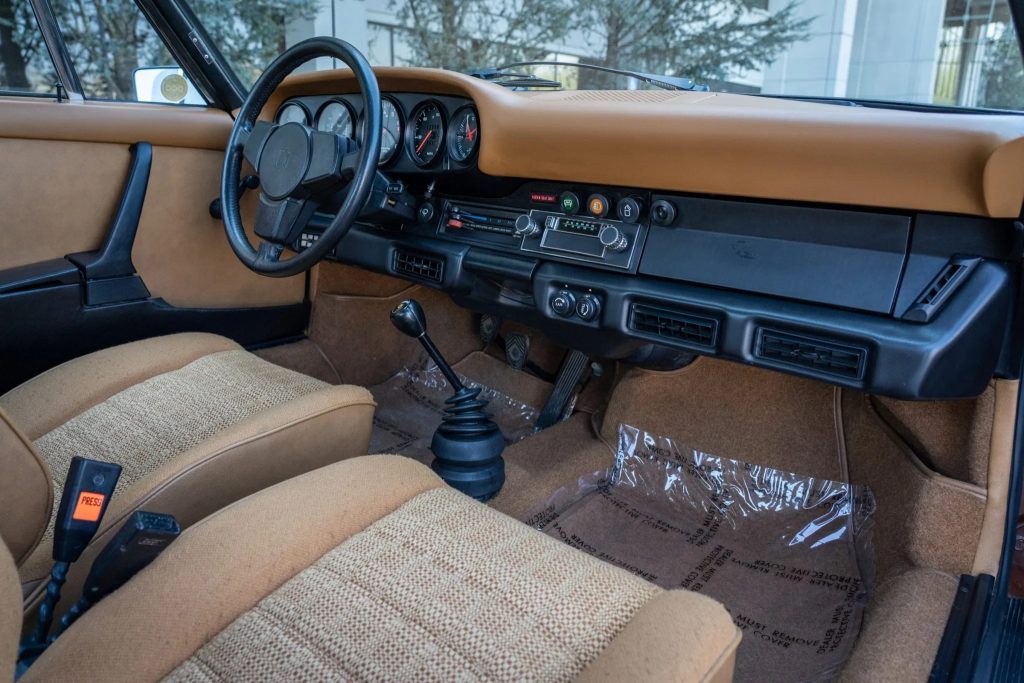
Being a mid-range 1970s air-cooled Porsche 911, the equipment list on this 911 S isn’t extensive. It has front fog lights, pop-out rear quarter windows, A/C, and a period aftermarket radio. But it does ride on Fuchs alloy wheels and the seats have tweed inserts.

The tan-cloth front seats and black-and-tan dashboard of a 1975 Porsche 911 S
1975 Porsche 911 S front interior | Bring a Trailer

One of the writers at MotorBiscuit, Gabriel Vega, owns a G-Series Porsche 911. And in his experience, these cars’ A/C can underperform. However, given that the seller of this 1975 911 S replaced the A/C belt, that doesn’t appear to be an issue. And that belt was only one of the most recent service items.

Besides the A/C Belt, this 1975 Porsche 911 S received a new fuel pump, transaxle case gasket, air filter, and steering rack boot in May 2021. Bring a Trailer also notes this car received an engine-out service in 2018 that included a fuel system overhaul, a new clutch, and a new rear main seal. And in preparation for the sale, the seller rebuilt the rear brake calipers, flushed the brake fluid, and installed new brake hoses.

It’s an affordable, well-maintained classic

As of this writing, this 1975 911 S is listed on Bring a Trailer at $22,250 with two days left in the auction. Considering the average BaT price for an impact bumper Porsche has crept closer to $50K, this 1975 car is a true bargain.

It’s worth pointing out that early G-Series 911s have a reputation for heat-related engine issues. However, as this car demonstrates, most cars from this era have rebuilt, modified, or replacement engines, Hagerty and PCA note. The hard repair/maintenance work has already been done on this car. That makes this 911 S a great way to get into affordable air-cooled ownership.

Follow more updates from MotorBiscuit on our Facebook page.

RELATED: Storied 1984 Porsche 911 Was a Man’s Home For Years and Now it Rides Again

The post Bring a Trailer Bargain of the Week: 1975 Porsche 911 S appeared first on MotorBiscuit.