
by Gabrielle DeSantis

Buying a brand-new pickup truck could quickly become a financial nightmare if you don’t stop and consider your vehicle’s future resale value. Let’s face it. While most consumers often finance a new truck with the intent of keeping it long-term, a sizable portion decides to upgrade after just a few years. As a result, picking a truck that’ll hold its value can seriously pay off, even in the short term.

To help with this, Kelley Blue Book compiled a list of the top 3 models with the predicted resale value after a five-year period. Instead of running through dozens of models, we’ll look at the best options within each segment. Spoiler alert, two of the top three are Toyotas.

Best midsize truck: 2021 Toyota Tacoma

2021 Toyota Tacoma Off Road with TRD Lift Kit | Toyota

Starting off this list of trucks with the best resale values is the 2021 Toyota Tacoma. If you’re a fan of midsize trucks, this result won’t surprise you. In fact, the Tacoma is so popular that buyers are willing to pay over MSRP for one given the recent new-vehicle shortage.

Regardless of which trim level you go for and how much you end up paying, the Tacoma is a solid choice long-term. That’s because KBB estimates that this midsize model will retain at least 55.8 percent of its original value after five years. For context, NerdWallet estimates that most cars will lose at least 60 percent or more of their value during the first five years. As a result, the Tacoma is a solid buy.

When looking at the 2021 Toyota Tacoma, it’s not hard to see why it has one of the best resale values around. Unlike most brand-new trucks, the Tacoma doesn’t feature a complex powertrain. Instead, you get a body-on-frame design, robust styling, and a naturally aspirated engine that’ll last forever.

Best full-size truck: 2021 Toyota Tundra
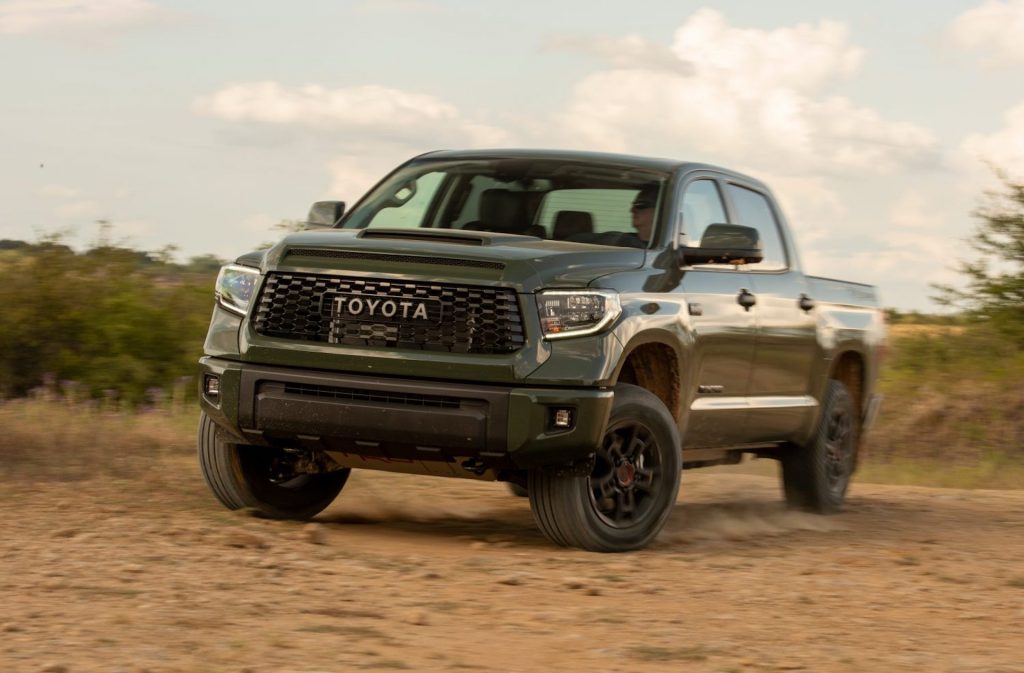
An image of a Toyota Tundra outdoors.
Toyota Tundra | Toyota

RELATED: Best Used Pickup Trucks Under $10,000 – the Top Pick Comes From Japan

Next up in this list of trucks with the best resale values is another contender from Japan with the 2021 Toyota Tundra. While the Tundra hasn’t received any major powertrain updates for over a decade, this is actually a good thing. Like with the Tacoma, the Tundra’s simple-yet-robust powertrain ensures that customers routinely see long-term ownership experiences with minor issues.

As a result of these upsides, it won’t surprise you to learn that the Tundra should retain around 59 percent of its original value after five years. Aside from beating the industry average by a considerable amount, this Toyota has the best resale value of any brand-new truck, says KBB.

As mentioned earlier, this is especially significant because this Japanese truck is beating the best America can put out, despite being 14 years old.

Best heavy-duty truck: 2021 GMC Sierra HD

An image of a 2021 GMC Sierra HD parked outdoors.
2021 GMC Sierra HD | GMC

Rounding up this list of trucks with the best resale values is one of America’s largest and more powerful offerings with the 2021 GMC Sierra HD. With a max towing rating of 36,000 lb, the Sierra HD is equally capable as a daily commuter or a work vehicle. As a result of this robust construction, you might want to buy one and keep it for a considerable amount of time.

If you decide to pull the trigger on one, KBB estimates that it’ll retain around 56.8 percent of its value after five years. If you intend to utilize it as a work vehicle, you can even trade up after a few years while paying a lighter penalty than all of its competitors.

The post Top 3 Brand-New Trucks With Best Resale Values According to KBB appeared first on MotorBiscuit.

by Gabrielle DeSantis

Only the most talented craftsmen built boats in more primitive times. Skill went into designing marine vessels, and the type of wood used to construct them meant the difference between sinking or sailing. That attention to detail and design continues with Chris-Craft boats. And though today’s boating consumers want pleasure cruisers and not the fishing and trading vessels of yesteryear, they still appreciate the craftsmanship in Chris-Craft vessels.

As technology and innovations evolved over the years, boatbuilding techniques have also changed. But water-loving enthusiasts know Chris-Craft boats still command respect through high-quality production. And like the ancient boatmakers, the longtime manufacturer has made a name for itself through unique engineering and a specific type of wood.

Chris-Craft’s long, rich history of boatmaking 

It was the late 1800s when brothers Christopher Columbus Smith and Hank Smith combined their boatbuilding talents and formed Chris-Craft. They were thrill-seekers, always looking for ways to improve their Lake Michigan adventures with powerboats. Designs began with steam engines, but by 1910, the mahogany boats could reach 33 mph with their 100-hp gas-powered engines. The Baby Reliance II model became the first boat to clock over 50 mph with its 53.7-mph run.

At the time, Chris-Craft was the only manufacturer using in-line production of wood-planked vessels. These boats garnered enough popularity and success that the company endured through the Great Depression and World War II, Wood Magazine reported. And today’s Chris-Craft boats are synonymous with luxury pleasure cruising.

How much does a Chris-Craft boat cost?

RELATED: Are Pontoon Boats Safe In the Ocean?

Expect the same level of quality in production when you buy a Chris-Craft boat today. The Smith family sold out in the 1950s, and the company’s headquarters moved from Michigan to Sarasota, Florida, USA Today reported. But the tradition of high-quality luxury powerboats continues with more modern styles and capabilities.

On the Chris-Craft website, you can browse available models, including the Corsair 30, Corsair 34, and the Catalina 27. These crafts can vary in price from $10,000 up to $675,000 depending on the size and model.

A diamond in the rough

Chris-Craft boats are diamonds in the rough because of their classic reputation for excellence in construction. Artisans built these beautiful vessels with stunning woodwork throughout. Collectors seek out vintage models, and many are still on the water through restoration.

Celebrities such as Elvis, Frank Sinatra, and Katharine Hepburn favorited these crafts. But finding some of these gems of yesteryear is tough. And their rarity adds to their allure.

The type of wood that makes them special

A Chris-Craft original featured a double-planked bottom made of Philippine mahogany. The Smiths incorporated a water-repellent layer of oil-saturated canvas between those rows of planking. They even plugged the screw holes with Philippine mahogany for airtight water protection.

Before using Philippine mahogany, Chris-Craft boats used Honduras mahogany. But to qualify for the 1920 international Harmsworth Trophy boat race, materials had to change to align with the U.S.-protected territory of the Philippines instead. And structural members of the crafts would feature native oak lumber, as well.

Wooden boats became nearly obsolete around the 1980s. Chris-Craft ventured into fiberglass production in 1955 and metal designs in 1957. But even today’s modern designs hark back to the iconic crafts of years past. Boating enthusiasts continue to appreciate these boats’ high-quality luxury designs. And if you’re lucky enough to see, own, or ride in a Smith-designed original, you’ll witness how impressive these boats were.

The post What Type of Wood Are Chris-Craft Boats Made Of? appeared first on MotorBiscuit.

by Gabrielle DeSantis

The rising prices of new and used cars lately have made it hard for some car buyers to find the right car for their needs. Most car shoppers are looking for a good deal, and if you happen to be an enthusiast that’s into Japanese sports cars, then it can be tough nowadays. However, all is not lost. There are still some popular Japanese cars that can still be bought for less than $10,000. Here are 10 of the fastest examples.

Acura Integra

2001 Acura Integra | Acura

RELATED: Are Japanese Cars Really More Reliable?

No, we’re not suggesting to peruse the classifieds for an Acura Integra Type R. There’s no way you’ll even find one of those for less than $25,000 nowadays. Fortunately, you can still find a non-Type R Integra for around $3,000 to $5,000, depending on its condition. The lower-trim Integras came with a 140-hp, 1.8-liter engine, while the upper-trim Integra GSR came with a 170-hp engine. Both of those platforms are great for either modifying or just having fun while driving it daily.

Honda Del Sol

a red 1995 Honda Del Sol
1995 Honda Del Sol | Honda

RELATED: 10 Reasons Why We Buy Japanese Instead of American Cars

Honda Del Sols are getting a little harder to find, but you can still find them for less than $10,000 when you do. The Del Sol was based on the 92-95 Honda Civic and was in production until 1997. Does this car sound old? It is, but luckily, OEM replacement and aftermarket parts for it are cheap and it’s easy to make a Del Sol fast with a little bit of money.

The first-generation Toyota MR2

1989 Toyota MR2
1989 Toyota MR2 | Wikimedia Commons

RELATED: 8 Japanese Cars That Will Be Worth Big Money

The first-generation Toyota MR2 was in production from 1984 to 1989. It featured a lightweight, wedge-like design, a responsive engine, and a 50/50 distribution for agile handling. Considering the age of the car, it could be tough to find a clean one. But hold out and you’ll enjoy the featherweight thrills that this plucky little two-seater has to offer.

Mazda RX-7

1991 Mazda RX-7
1991 Mazda RX-7 | Wikimedia Commons

Sure, rotary engines can be tough to maintain and they aren’t very efficient. But nothing beats the sound and feel of revving one up to the stratosphere to get to wherever you’re going quickly. The first two generations of the Mazda RX-7 came with naturally aspirated versions of the rotary engine and can still be found for under $10,000. However, don’t go looking for a third-gen RX-7, you could be in for some sticker shock.

Nissan 350Z

a blue 2005 Nissan 350Z
2005 Nissan 350Z | Nissan

Produced from 2003 to 2009, the Nissan 350Z is a crowd favorite among Japanese car enthusiasts. Heralded for its potent V6 engine, sharp handling characteristics, and rear-wheel drivetrain, the 350Z is a great option if you’re looking to spend less than $10,000.

Mitsubishi Eclipse

a siver 1995 Mitsubishi Eclipse
1995 Mitsubishi Eclipse | Wikimedia Commons

Yes, finding a Mitsubishi Eclipse in any shape or form is rare nowadays. But if you can find a second-generation Eclipse, then you’ll be very happy. Not because it’s a fun tuner car that can be upgraded easily, but also because you’ll likely spend a lot less than $10,000 on one. Possibly even less than $5,000.

Mazda Miata

Mazda MX-5 Miata
Mazda MX-5 Miata | Mazda

Out of all of the cars on this list, a Mazda Miata should be the easiest to find. The automaker has sold millions of copies since the car debuted in 1990, so there are plenty of used ones to go around. And while it might only have about 100 hp to start with, the Miata can be modified and engine swapped to your liking. Possibly for less than a total of $10,000 as well.

Toyota Celica

1991 Mazda RX-7
1991 Mazda RX-7 | Wikimedia Commons

There are plenty of older Toyota Celicas to be found, however, you’ll want to find a seventh-generation example, if possible. According to The Things, the last iteration of the Celica GT-S was powered by a 2ZZ engine that produced 180 hp and revved to 8,000 rpm. If that doesn’t like fun, we don’t know what does.

Mazdaspeed3

Mazdaspeed3
Mazdaspeed3 | Wikimedia Commons

The Mazdaspeed3 was based on the Mazda3 at the time but featured a potent turbocharged 2.3-liter engine that pushed out 256 hp. What’s even better is that it also had a six-speed manual transmission, which made it fun to drive. But what’s even better than that is that you can currently find them for sale for under $10,000. Now that’s a deal.

Honda Civic Si

2002 Honda Civic Si https://www.motorbiscuit.com/5-ways-prevent-thieves-stealing-catalytic-converter/
2002 Honda Civic Si | Wikimedia Commons

While you might not be able to find one of the newer Honda Civic Si models for under $10,000, you can still find the 2002 to 2005 models for that cheap. Those hatchback versions featured a European build quality, a 160-hp engine, and agile handling.

If you want something newer, then you can even find a 2006 to 2011 model for under $10k. That version had a higher-revving, 200-hp K20 engine that’s revered by many as one of the best engines the automaker has ever created.

The post 10 of the Fastest Japanese Cars For Under $10,000 appeared first on MotorBiscuit.

by Gabrielle DeSantis

Infotainment systems feel like standard equipment now, but that wasn’t always the case. We’ve come a long way from the days of analog clocks embedded in dashboards. With the push to make cars 30 years ago, Buick installed a touchscreen that was decades ahead of its time. This moment in automotive history paved the way for the high-tech systems we now take for granted. In the 1980s, it seemed like a slice of science fiction.

Buick Logo | Artur Widak/NurPhoto

Buick has a history of automotive innovation

The Buick brand was born of ingenuity. More than 100 years Buick made a name for itself and stood out in the automotive industry by revolutionizing engine performance. An employee of Buick invented the overhead valve, changing the future of performance engines.

Future General Motors founder William C. Durant purchased Buick and its intellectual property, including the overhead valve. The overhead-valve design was immediately implemented in the Buick Model B. This car put out a full liter more displacement than any of its contemporaries and pushed 25% more horsepower.

Buick isn’t necessarily known for being at the cutting edge of automotive technology. The brand is synonymous with large, comfortable sedans. This reputation largely overlooks the companies many contributions to automotive innovation. Publications like Popular Mechanics have

The technology behind this advancement is striking

RELATED: Why the 1956 Buick Centurion Was the Car of the Future

In 1986 the average car was not loaded with high-tech features. Many buyers preferred to opt for simplicity and economy over extra bells and whistles. That doesn’t mean that there weren’t a lot of high-tech features pioneered during the decade. Many of the features considered standard now could be found decades ago if you knew where to look.

Buick made a bold move that same year when it introduced the Graphic Control System to the market. Featured in a select number of 1986 Buick Rivieras, the GCC was a two-color touch screen. This touch screen allowed drivers to control systems like the heating and radio. This system may look dated now, but its technology is impressive.

The GCC screen took a few seconds to start up. Buick engineers designed it to begin turning on as soon as the driver’s door handle was touched. After 30 seconds, the screen would automatically shut off if the engine was not started. If the ignition were turned, the screen would display the driver’s home screen, which featured the most basic controls.

The touchscreen featured invisible mylar switches over its two-color display. These controls gave drivers information and access to the Riviera’s automatic climate control, AM/FM radio with optional graphic equalizer, trip calculations, gauges, and vehicle diagnostic information. Executives at Buick loved the system. Cary Wilson was quoted as saying:

Buick executives knew they were ahead of their time

Buick Riviera 1963. By Simon Clay. (Photo by National Motor Museum/Heritage Images/Getty Images)

RELATED: The Buick Electra Concept Proves the Brand Isn’t Just Your Grandad’s Grocery Getter

The touchscreen featured invisible mylar switches over its two-color display. These controls gave drivers information and access to the Riviera’s automatic climate control, AM/FM radio with optional graphic equalizer, trip calculations, gauges, and vehicle diagnostic information. Executives at Buick loved the system. Cary Wilson was quoted as saying:

The touchscreen featured invisible mylar switches over its two-color display. These controls gave drivers information and access to the Riviera’s automatic climate control, AM/FM radio with optional graphic equalizer, trip calculations, gauges, and vehicle diagnostic information.

Executives at Buick loved the system. Cary Wilson was quoted as saying: “I believe this system makes Buick a world leader,” Wilson said in 1986. “A new generation of automobile electrical systems is at hand, and Buick has set the stage.”

The post This Buick Had A Touchscreen In 1986 appeared first on MotorBiscuit.