
by Gabrielle DeSantis

Last year, the pandemic wreaked havoc on the automobile industry. It saw breaks in supply chains, production plant closures, and decreased sales. More than a year later, a chip shortage is affecting new-car production, causing an inventory reduction. As automakers scramble to meet consumer demand, shoppers are looking at used cars. And two used Honda CR-V models under $20,000 can meet buyers’ needs during this difficult time.

Global chip shortage might affect your new car purchase

Sometimes a pre-owned car is better than a new one. Not only is there substantial cost savings, but drivers can get more bang for their buck with advanced safety features and luxury options that may not be affordable in a new model.

The chip shortage is affecting new vehicle production and delivery. Consumer Reports explains, “With the pandemic-related, global shortage of chips needed for car safety and infotainment systems, shipments of new cars are often delayed or coming in at lower-than-expected volumes.”

The result, CR says, “means supply is short and new-car dealers are charging a premium.”

Consumer Reports’ ‘Best Used Cars and SUVs for $15,000 to $20,000’ 

RELATED: The Standard 2021 Honda CR-V Makes Insurance Lighter on Your Wallet

Because of the increased demand for used cars, it’s helpful to reference Consumer Reports’s “Best Used Cars and SUVs for $15,000 to $20,000.”

Safety is a primary concern for consumers. Most of the listed vehicles provide active safety features such as blind-spot warning, automatic emergency braking, and forward-collision warning. All the cars on the list also have electronic stability control.

The selected used cars also performed well on the Annual Auto Survey, with better than average predicted reliability scores.

Recommended vehicles in the small car category include the 2017 and 2018 Chevy Bolt, Honda Fit, Mazda3, Volkswagen Beetle, and Toyota Corolla. Consumer Reports also considers the 2016 and 2017 Toyota Prius and Prius V, 2017 Prius Prime, and 2018 Prius C good choices.

Midsize vehicles include the 2015 and 2016 Toyota Avalon and Honda Accord, the 2016 and 2017 Toyota Camry, and the 2017 and 2018 Mazda6. In the luxury segment, the 2011 and 2012 Lexus LS, 2013 to 2015 Lexus ES, 2013 Lexus GS, 2014 and 2015 Infiniti Q50, and 2015 and 2016 Acura TLX are CR’s picks.

The small SUV class includes the 2016 to 2018 Honda HR-V, 2016 and 2017 Mazda CX-5, and 2018 and 2019 Hyundai Kona. Midsize SUVs include the 2011 and 2012 Toyota 4Runner, and the 2013 and 2014 Lexus RX and Toyota Highlander.

Then there are two Honda CR-V model years.

CR recommends these 2 Honda CR-V model years

RELATED: This Is the Best Used Honda CR-V Model Year to Look For

Consumer Reports recommends the 2015 and 2016 Honda CR-V among the best used cars from $15,000 to $20,000.

This used compact crossover SUV costs around $15,825 to $21,475. Receiving a refresh in 2015, the CR-V received a 2.4-liter four-cylinder engine paired with a smooth-shifting continuously variable transmission. Also, its fuel efficiency improved to an estimated 24 mpg to 27 mpg combined.

The 2015 model update includes technological updates with a standard backup camera. A touchscreen infotainment system comes standard in the EX trim level and above, along with Honda’s Lane Watch safety feature.

And the 2016 Honda CR-V received a vast array of advanced safety features. They include forward-collision warning, lane-keeping assist, and automatic emergency braking.

With so many good used car options on the market, the chip shortage may not be a problem after all. But keep an eye on used-car prices, because they could climb too.

The post 2 Used Honda CR-V Models Between $15,000 and $20,000 Will Soothe Your Chip Shortage Suffering appeared first on MotorBiscuit.

by Gabrielle DeSantis

The Nissan Rogue is one of the most popular options if you’re looking for an affordable yet capable SUV. It touches on just a bit of everything buyers are looking to get out of a new SUV without breaking through to a more expensive price point. The Rogue is even available with several trim levels and drivetrain variations to appeal to different drivers who may want or need different things from the popular car. With so many options to pick from, what trim level is the best bang for your buck without having to upgrade to the most expensive, highest trim level of the 2021 Nissan Rogue.

Nissan Rogue Sport | Sjoerd van der Wal, Getty Images

Which 2021 Nissan Rogue trim should I purchase?

Of course, there are a variation of Nissan Rogue trims that are designed to include a wider range of buyers, but if you see them as relatively equal across the board, it doesn’t hurt to have some guidance. According to Edmunds, the SV trim level for the 2021 Nissan Rogue is a seemingly fool-proof option, though the website does note that other trim levels are also great contenders.

The SV trim level is only the second trim level option, making it one of the more affordable choices. You can pick up a base model Rogue for an MSRP of $27,385, but just for a bit more, you can upgrade one trim level to the Rogue SV for $30,545. With the small increase in price, you do get quite a bit more from the SV trim.

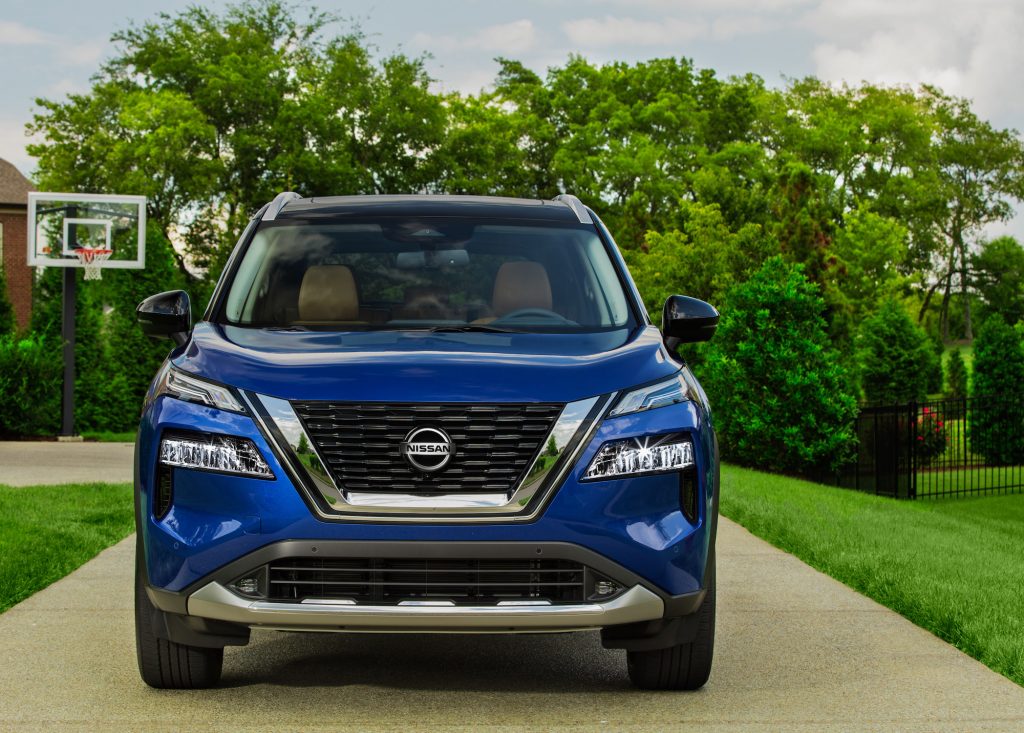
A blue 2021 Nissan Rogue parked in a suburban driveway with a basketball hoop
2021 Nissan Rogue | Nissan Motor Corporation

What does the Nissan Rogue SV trim include?

There are plenty of standard safety features that run across the board for all of the 2021 Nissan Rogue trim levels. This includes the Nissan Safety Shield, which comes in handy with all of the important safety tech and features drivers are looking for on the market, as well as a few additional driving aids that genuinely enhance the driving experience. Safety Shield includes:

  • Forward collision mitigation
  • Lane departure warning
  • Rear cross-traffic alerts
  • Blind-spot monitoring
  • Rear automatic braking
  • Safe exit for rear passengers

Along with these standard safety features, the SV also has some valuable upgrades making it worth choosing over the base model Rogue. Many of these are more luxurious features that give the car an upscale and modern feel, like a 360-degree camera system, keyless entry and start, and adaptive cruise control.

RELATED: Does the 2021 Nissan Rogue Offer an All-Wheel Drive Option?

The SV Premium Package gives buyers some added bonuses

If you want a bit more luxury and features but don’t want to spend the money jumping to the next trim level, the SV Premium Package might be exactly what you’re looking for. It comes with everything that the base model and SV trim level have to offer in the way of tech and safety features but adds in a dash of class.

From the outside, the SV Premium Packages gives the 2021 Nissan Rogue SV a beautiful panoramic sunroof, power liftgate, and roof rails for extra storage. Inside, you can expect faux leather upholstery heated front seats, second-row sunshades, and a leather-wrapped steering wheel.

RELATED: Does the 2021 Nissan Rogue Already Have a Recall?

The SV trim is just one of several options available for the 2021 Nissan Rogue, but there are plenty of other trim levels and drivetrain options to mix and match if you’re looking for something slightly different. For the 2021 model year, all trim level options come equipped with a 2.5-liter 4-cylinder engine, but drivers can choose between standard front-wheel drive or upgrade to all-wheel drive, which is available across all of the trim level options.

The post Which 2021 Nissan Rogue Trim is the Best Bang for Your Buck? appeared first on MotorBiscuit.

by Gabrielle DeSantis

When it comes to getting your driver’s license for the first time, it can be exciting, but also nerve-wracking. Most states allow student drivers to get their license typically between the ages of 16 and 17 years old, and while some states offer driver’s ed, that isn’t always the case across the board. There aren’t any specifications as to what type of car you have to bring for your driving test, but in most cases, it has to be safe, has working headlights, taillights, and brake lights, and, of course, seat belts. Other requirements may vary by state, but apparently, there is no rule saying you can’t take your driving test in a hypercar, like this 17-year-old who took his in a Bugatti Chiron.

Getting your driver’s license in a hypercar

Taking the driving test to get your official driver’s license from the DMV can be an exciting moment that many teenagers look forward to, but it can also be a bit intimidating. Sprinkle on the stress of taking your driving test in a multi-million dollar vehicle, and you’re in for an interesting story that might be a bit more interesting to tell after the stress and excitement of the moment has passed.

Bugatti Chiron | Paul Marotta, Getty Images, Audrain

Can you take the DMV driver’s license test in a hypercar?

There are several requirements for vehicles when it comes to taking your driver’s license driving test with the DMV. These requirements may vary slightly depending on what state you live in, but they are overall in place to ensure that the vehicle you are driving is safe for yourself and other drivers on the road.

In order to use a vehicle to participate in your driver’s license test, the vehicle must be safe and street legal. That means it must have operating headlights, taillights, brake lights, turn signals, seatbelts, and several other crucial safety features. These requirements may vary by state as some states require vehicle inspections while others do not.

A river steers a Bugatti Chiron
A driver steers a Bugatti Chiron | PATRICK HERTZOG, AFP, Getty Images

RELATED: This Wide-Body Lamborghini Aventador is a Beautiful and Heart-Wrenching Tribute

Technically speaking, there is no law against driving an exotic car, super car, or even a hypercar like the Bugatti Chiron, for your driver’s license exam, though the opportunity is rather unique — after all, it is a fairly rare and expensive vehicle.

Taking your driver’s license exam in a Bugatti Chiron

James, also known by his YouTuber handle The Stradman, picked up his young friend Matt from high school and drove him to the DMV in a bright yellow, 1500 hp Bugatti Chiron. If the pressure of getting your driver’s license and passing the DMV driving test isn’t stressful enough, imagine doing it in a Bugatti.

Of course, just because it’s a high-end exotic car doesn’t mean the DMV skipped out on all of the standard checks, and the instructor did her due diligence in checking every aspect of the vehicle as if it was a more standard, less exciting vehicle.

RELATED: Keanu Reeves Meets Drunk Automotive YouTuber in This Cringy Tale

In case you’re wondering and you don’t want to make it all the way through the video, Matt did in fact pass his driver’s license test driving the Bugatti Chiron.

The post Teenager Takes DMV Driver’s License Test in a Bugatti Chiron appeared first on MotorBiscuit.

by Gabrielle DeSantis

Even if you don’t crash, racing often means dealing with various mechanical issues and part failures. For example, Tyler O’Hara’s rear brakes failed at the 2020 King of the Baggers. And sometimes, these problems happen to road cars, too. Case in point, the wheel nut issue that plagued Mercedes F1 racer Valtteri Bottas at the Monaco Grand Prix.

A rounded wheel nut meant the end of the race for Mercedes F1 driver Valtteri Bottas

The wheel nut and Brembo brake disc on a Formula GP3 car | Zak Mauger/Formula Motorsport Limited via Getty Images

Formula 1 cars are significantly different than road cars, but they do have several things in common. Notably, F1 cars have wheels that need to attach securely to the wheel hubs and axles. Road cars achieve this by using multiple lug nuts attached to individual wheel studs. F1 cars, though, have center-lock wheels with a singular wheel nut.

Center-lock wheels with wheel nuts are an evolution of the ‘knock-off’ wire wheels found on many early sports cars, The Drive explains. And they’re not designed to reduce unsprung weight. Rather, a single wheel nut is quicker to remove and reinstall than multiple lug nuts. And considering an F1 pit stop is sometimes less than two seconds long, Car and Driver reports, speed is vital.

A red-black-and-orange Formula 1 wheel nut gun laying on the ground
Formula 1 wheel nut gun | Mark Thompson/Getty Images

That’s why professional racing crews use specialized sockets and wheel guns to get the wheel nuts on and off, Car and Driver explains. At its core, a wheel gun is essentially an impact wrench, only it spins significantly faster and with more force. The ones F1 pit crews use spin at 10,000 RPM with over 2000 lb-ft of torque, The Drive reports. And a spinning piece of metal, whether a saw blade or a wheel nut socket, is a grinding tool waiting to happen.

Valtteri Bottas experienced that firsthand at the 2021 Monaco Grand Prix recently. Normally, the wheel guns’ sockets mesh with the teeth on the F1 car’s wheel nuts, Road & Track explains. Only this time, during a pit stop on Lap 30, that didn’t happen on Bottas’s right front wheel.

Instead, the sprocket and wheel nut were misaligned, and when the socket spun, it sheared the teeth and jammed the nut firmly in place. Mercedes had to ship the car back to the factory to get it off, Autoweek reports.

Regular cars’ wheel and lug nuts can get rounded down or stripped off, too

A JLR employee fits lug nuts on a 2015 Land Rover SUV
JLR employee fits lug nuts on a 2015 Land Rover SUV | Simon Dawson/Bloomberg via Getty Images

What Bottas experienced in Monaco is what’s known as a ‘stripped’ or ‘rounded’ wheel nut. As in, the once sharp edges of the nut are rounded down so the socket no longer grips it tightly.

The risk of rounding/stripping lug nuts is one reason why impact drivers and wrenches demand careful use, NAPA explains. Because they spin so quickly, they often wear down the sharp edges, making the nuts more difficult to remove.

RELATED: Planning to Autocross? Here Are Some Helpful Tips to Get You Started

Plus, while they make removal easier, impact drivers can also over-tighten the lug nuts and damage the wheel stud threads, Autoblog reports. That happened to me at various tire shops, which lead to several new studs and a predilection for hand tools. Over-tightening can also damage the nuts themselves, which can lead to corrosion. Particularly if the nuts are cheaply designed, as some Ford F-150 owners discovered.

If it happens, how can you fix it?

RELATED: Formula1 Engines are Made with…Sand? Donut Media Explains

Preventing wheel nut and lug nut rounding isn’t necessarily difficult. It’s a matter of properly fitting tools and good technique. And if you’re not on a pit crew, you don’t have to remove the nuts quickly. If you’re removing them with an impact driver, go slowly to prevent damage. And the best way to screw the nuts back on is with a torque wrench, Autoblog reports.

But sometimes, you accidentally round off your wheel nut or buy a car with stripped lug nuts. Luckily, there are several ways you can try and remove it.

RELATED: Should You Shine Your Car Tires?

The most straightforward method is to use a socket one size smaller attached to a long breaker bar, 1A Auto explains. Whack the socket with a hammer to seat it firmly, then use the breaker bar’s leverage to torque the nut free. You can also use a lug nut extractor socket specifically designed for this purpose, Garage Chief explains.

If that doesn’t work, another option is to use a screwdriver as a chisel to make a notch in the lug nut. Then, using a hammer, tap and twist the screwdriver to rotate the nut. Cycle World had to do something like this with a sheared bolt on a Harley-Davidson Sportster scrambler in Scram Africa.

RELATED: Is Your Car’s Starter Motor Going Bad?

If none of these methods work, you can try to grind new edges onto the lug or wheel nut with an angle grinder. And if that’s still not enough, the last resort is what Mercedes is doing to Valtteri Bottas’ car: drill it out.

Follow more updates from MotorBiscuit on our Facebook page.

The post Could F1 Driver Valtteri Bottas’ Wheel Nut Issue Happen to You? appeared first on MotorBiscuit.