
by Gabrielle DeSantis

Don’t count compact cars out of the race yet. In fact, Honda Civic sales are up over 100% year-over-year and the Toyota Corolla has seen a sales increase of over 300% since this time last year. Of course, the pandemic has a lot to with the massive increase, but it also proves that many consumers are still purchasing compact cars.

And while stalwarts like the Honda Civic and Toyota Corolla remain leaders in the category when it comes to sales, there’s one Hyundai model that beat both of them on another list. Specifically, Kelley Blue Book’s “Best Small Cars for 2021” list.

The 2021 Hyundai Elantra is a surprisingly efficient compact car

2021 Hyundai Elantra | Hyundai

RELATED: The ‘Best Overall Truck Brand’ According to KBB

The Hyundai Elantra was redesigned for the 2021 model year and with it came sharp styling inside and out and hybrid car-like fuel efficiency. According to the EPA, the Elantra Hybrid is rated at 50 mpg in combined driving, which is right below the Prius’ 52 mpg in combined driving.

But if you would rather have a sportier experience, then the Elantra N Line comes with either a six-speed manual or DCT transmission. Either one is a perfect pairing for its 201-hp, 2.0-liter turbocharged engine. But of course, if you would rather have a normal commute, then the regular Elantra line produces superb fuel efficiency and power as well.

The 2021 Honda Civic is a mainstay in the group

2021 Honda Civic in red
2021 Honda Civic | Honda

RELATED: The Highest-Rated Trucks of 2021 According to KBB

Kelley Blue Book says that the 2021 Honda Civic is “reliable, safe, and fun to drive,” and we couldn’t agree more. All of that, mixed with a starting price under $22,000, it’s no wonder that U.S. News ranked it as No. 1 on its list of compact cars. However, it came in second on KBB’s list. But we have no doubts that the redesigned 2022 Civic will do well next year.

Safety and reliability are the 2021 Toyota Corolla’s strong points

2021 Toyota Corolla driving, the 2021 Toyota Corolla is among the best new cars under $30,000
2021 Toyota Corolla | Toyota

RELATED: The Best Affordable Hybrids Under $40,000 According to KBB

While the Toyota Corolla has never been known to be sporty, it has always excelled greatly in reliability and safety. The 2021 Corolla is no different as it’s available with a host of standard safety features and is as reliable as it has ever been. Consumer Reports even gave the 2021 Toyota Corolla a five out of five when it comes to predicted reliability.

The 2021 Toyota Corolla Hatchback is fun to drive

A silver 2021 Toyota Corolla Hatchback driving
2021 Toyota Corolla Hatchback | Toyota

If you do want a little sportiness in your Corolla, then you can also opt for the 2021 Toyota Corolla Hatchback. This plucky little five-door has a stronger 168-hp, 2.0-liter engine accompanied by either a CVT or a six-speed manual transmission. The Corolla hatchback also comes with the same safety features as its sedan counterpart, but offers a fun-to-drive, go-cart-like package.

The 2021 Kia Forte has one of the best warranties in the segment

A red 2021 Kia Forte driving
2021 Kia Forte | Kia

If you’re looking for a practical means of transportation, but want to save a few thousand dollars, then the 2021 Kia Forte could fit the bill. With a starting price under $19,000, the Forte offers a lot of value for the money. And what’s even better is that it comes with a 10-year/100,000-mile warranty, which is better than any other car on this list.

The 2021 Nissan Sentra looks a little more upscale

A red 2021 Nissan Sentra compact sedan parked between two mountains in front of dark clouds
2021 Nissan Sentra | Nissan Motor Corporation

The Nissan Sentra was just updated last year and is now much more upscale than ever before. According to Kelley Blue Book, the Nissan Sentra has “laudable driving dynamics and tech for a value price.” We don’t doubt it, considering the Sentra starts at a reasonable $20,355.

The 2021 Mazda3 provides a luxurious touch

A parked 2021 Mazda3
2021 Mazda3 | Mazda

If you want a little more luxury out of your compact car, then the 2021 Mazda3 has you covered. In addition to a fuel-efficient engine and the availability of all-wheel-drive, the Mazda3 has an interior that you would expect from a class above. We’re surprised that KBB didn’t put this one higher on the list.

2021 Volkswagen Jetta offers free maintenance

A silver 2021 Volkswagen Jetta driving
2021 Volkswagen Jetta | Volkswagen

The Volkswagen Jetta holds its own in the compact crowd by offering buyers a roomy interior with a large trunk, a refined cabin space with a superb fit and finish, and free maintenance. That’s right, if you buy a 2021 Jetta, you can take advantage of two years of free maintenance in addition to a 4-year/50,000-mile warranty.

All-wheel drive comes standard on the 2021 Subaru Impreza

A silver 2021 Subaru Impreza driving
2021 Subaru Impreza | Subaru

We’re surprised that the 2021 Subaru Impreza was last on KBB’s list. However, it’s still a force to be reckoned with in the lineup as it comes standard with all-wheel-drive, has superb safety ratings, and is known to hold its value over time.

The post Hyundai Surprisingly Beat Out Honda and Toyota on This KBB List appeared first on MotorBiscuit.
by Gabrielle DeSantis

Being green is important to a lot of people. One place that’s historically been tough to be green is when driving a car. The new Green Choice designation will help buyers easily find the vehicles with the lowest emissions. Buyers looking for a Green Choice large car don’t have much of a choice, though; the 2021 Toyota Avalon is the only large car that earned this designation.

What is Consumer Reports’ Green Choice designation?

Carbon dioxide and other greenhouse gases that come from vehicles contribute to climate change and the related concerns of heatwaves and droughts, extreme storms, and rising sea levels. Auto emissions are often especially bad in urban areas and disadvantaged communities, which have lots of major roads plus industrial sites, says Consumer Reports. People living in these areas have higher rates of pollution-related health concerns.

Luckily, new automotive technologies are making cleaner cars possible, even when they’re still gas-powered. Hybrid and all-electric vehicles don’t produce any emissions while driving. Consumer Reports’ new designation of Green Choice will help vehicle buyers locate these greener options. Green Choice vehicles are marked with a green leaf icon throughout the Consumer Reports’ website.

A car that earns the Consumer Reports Green Choice designation has low or zero emissions, so it pollutes less, producing lower levels of greenhouse gases and smog-causing gases. Green Choice is awarded to the highest 20 percent “of vehicles on the market with the cleanest emissions.”

The Green Choice vehicles are a better option for both human health and the environment. “EVs are best for the environment, but you can still meaningfully reduce your impact by choosing the right gas-powered car or truck,” says Jake Fisher, senior director of auto testing at Consumer Reports.

“About a quarter of CR’s recommended cars earn the Green Choice designation, including midsized vehicles and even some larger hybrid SUVs and minivans.” In addition to helping consumers, the Green Choice designation will also encourage auto manufacturers to make greener vehicles. One such vehicle is the Toyota Avalon.

The 2021 Toyota Avalon earns Consumer Reports’ Green Choice designation

The Toyota Avalon | Patrick T. Fallon/Bloomberg via Getty Images

RELATED: Do Electric Cars Produce a lot of Carbon Dioxide (CO2)?

Consumer Reports tests out lots of cars, and it gets additional emissions information from the Environmental Protection Agency’s SmartWay program. On Consumer Reports‘ list of the four large cars for 2021, only the Toyota Avalon was able to earn the Green Choice designation. The Nissan Maxima, Dodge Charger, and Chrysler 300 did not.

The Toyota Avalon Hybrid has a nine out of 10 rating from the EPA for greenhouse gas emissions (with 10 being the best). Its smog rating is seven out of 10. Non-hybrid versions of the 2021 Avalon are rated either five or six out of 10 for greenhouse gas emissions and five out of 10 for their smog rating. 

The 2021 Avalon is the only one of the four large cars that offers a hybrid option. The other three cars all have a greenhouse gas emissions rating from the EPA of five out of 10 and smog ratings of three out of 10.

The green 2021 Toyota Avalon Hybrid

RELATED: What Do They Test for in an Emissions Inspection?

The 2021 Toyota Avalon is a Green Choice because of its hybrid version. The Avalon Hybrid has a 2.5-liter four-cylinder engine paired with two electric motors. Combined, they generate 215 hp.

In an update new for the 2021 model year, the nickel-metal hydride battery has been replaced with a lithium-ion battery pack. The warranty for the hybrid battery was recently increased to 10 years from the date of first use or 150,000 miles. It had been eight years or 100,000 miles.

The Avalon Hybrid is rated for 42 MPG overall for its fuel efficiency, says Consumer Reports. The non-hybrid Avalon is rated for 25 MPG overall. However, U.S. News points out that many smaller hybrids do have better fuel efficiency.

In addition to its Green Choice designation, the 2021 Toyota Avalon Hybrid is a great pick for other reasons. U.S. News chose it as its 2021 Best Hybrid or Electric Car for Families, saying it has a “great combination of cargo and passenger space, safety and reliability ratings, positive reviews from automotive journalists, and available family-friendly features.”

There isn’t much of a price increase to get the hybrid version, so it’s worth taking a look at the 2021 Toyota Avalon Hybrid. The price for this Green Choice starts at $37,100.

The post The Toyota Avalon Is the Only Large Car to Earn This Consumer Reports Designation appeared first on MotorBiscuit.

by Gabrielle DeSantis

It’s hard to contain our excitement for the 2022 Toyota Tundra. This truck, which is often referred to as a dinosaur, is finally being redesigned. There are incredible upgrades to expect with the new Toyota Tundra. 

The 2022 Toyota Tundra is getting a new face 

2022 Toyota Tundra teaser | Toyota

While recent Toyota Tundra models still look great, they have carried over an older look for a few years. The last time that the Tundra had a full redesign was in 2007. That was 14 years ago. 

The Tundra did get a nice refresh in 2014 but has only had minor changes since then. In 2020 the Tundra got slightly updated tech, including an optional 8-inch touchscreen with Apple CarPlay and Android Auto, but it still feels behind. 

Now the 2022 Toyota Tundra is catching up to rivals, and we’ve finally received a little taste of what to expect. Toyota released a teaser image showing new LED headlights. It provides clues as to how the truck will be shaped and its size. 

What to expect with the new Toyota Tundra 

RELATED: Will the 2022 Toyota Tundra Outmuscle Rivals?

According to Car and Driver, the 2022 Toyota Tundra shows bold new headlights, a light bar that stretches across the middle of the grille where the Toyota Logo used to be, and new amber marker lights above the grille. Also, two more LED lights sit under the grille, so this truck is bright. 

The amber lights suggest that the Tundra could be over 80 inches wide. Its configurations have been slimmed down recently, and for 2021, the Tundra is only available in Double Cab or CrewMax variants. The only spy shots that have been captured so far look like a CrewMax variant with a short bed. 

The third-generation Toyota Tundra is expected to ride on the Toyota New Global Architecture (TNGA) platform for body-on-frame trucks. According to Gear Patrol, the platform could convert the Tundra to lighter construction materials to improve ride quality and safety. 

In the spy shots, the Tundra has a covered rear end. This may indicate that Toyota is hiding a new suspension setup. Current Tundra models use a leaf-spring setup in the rear, but the new one could have coil springs, air springs, or an independent rear suspension. 

Will the third-generation Toyota Tundra have more power? 

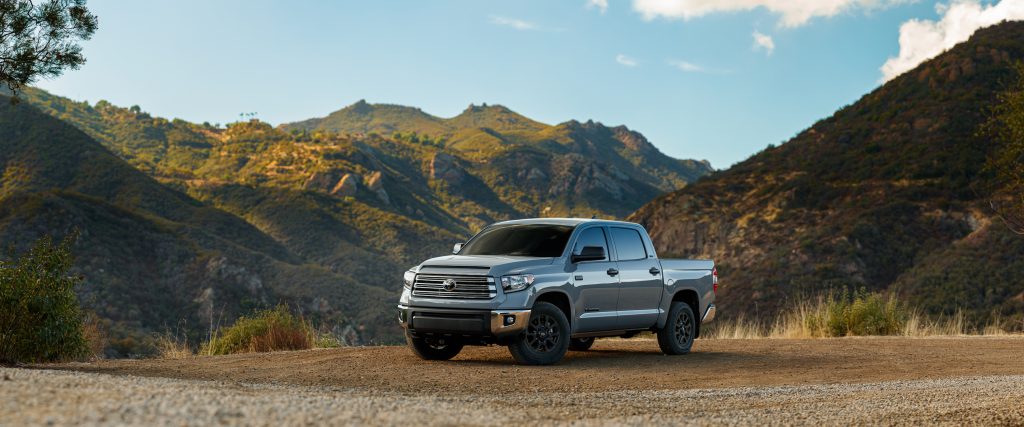
2021 Toyota Tundra parked in a field in the mountains
2021 Toyota Tundra | Toyota

The 2022 Toyota Tundra will need updated powertrain options to survive. This doesn’t mean that the current engine is bad, but it’s a little thirsty compared to rivals. Current Toyota Tundra models have a 5.7-liter V8 engine that pumps out 381 hp and 401 lb-ft of torque. 

It provides a powerful acceleration, and the Tundra can tow up to 10,200 lbs. But the 2021 Ford F-150 can tow up to 14,000 lbs, and the 2021 Chevy Silverado 1500 can tow up to 13,300 lbs, so the Tundra needs to catch up. 

The 2021 Tundra gets an EPA-estimated 13 mpg in the city and up to 17 mpg on the highway. But if the rumors are correct, the 2022 Tundra will receive a new twin-turbo 3.5-liter V6 engine, a new hybrid version, and an electric variant that could be in the works. The 2022 Tundra should make its debut soon, and we can’t wait to learn more.

The post The 2022 Toyota Tundra Has a Sharp New Face appeared first on MotorBiscuit.

by Gabrielle DeSantis

When Jeni Rieger bought her used 2015 Audi A4 back in August 2016, she was certain she had made a great purchasing decision. After all, Audi, a brand under the Volkswagen umbrella, has a reputation for being a high-quality, top-performing badge. But this Nevada native soon began experiencing trouble with her almost new Audi.

The Audi A4 | David Mareuil /Anadolu Agency/Getty Images

After a few visits to the dealerships, engine problems were fast becoming costly. And when she heard the issues weren’t going to be covered under warranty, she knew she had to do something. It was a third-party automotive repair shop that provided the clarity she needed.

And engine failure with certain Audi models, as it turns out, isn’t just a problem for Jeni Rieger. Based on the recently filed class-action lawsuit’s claims, Audi knew all about the potential engine failures.

The details of this class-action lawsuit

The class-action lawsuit was filed last month with Jeni Rieger as the plaintiff and Volkswagen AG, Volkswagen Group of America, Inc. d/b/a Audi of America, Inc., and Audi AG as the defendant. The lawsuit has been officially filed in the District Court of New Jersey, according to Justia docket data.

The allegations suggest Audi knew about the potential issues associated with oil consumption, engine power loss, and potential piston failure, despite refusing to cover the needed repairs as a warranty claim.

To back this allegation, representatives for the plaintiff point the past Technical Service Bulletins (TSB 17 13 43 2027731/5) that warned retail dealers about “engine oil consumption” with various Audi models featuring the 2.0T engines.

Defective piston parts could be the core problem

More details come to light as ClassAction.org lays out the various problems and potential lawsuit claims. Attorneys are investigating the Audi models’ pistons as the possible culprit leading to the various symptoms, including oil consumption.

It could be that the pistons are actually breaking into pieces, causing damage throughout and leading to potential engine failure. Symptoms Audi owners might experience include a sudden loss of power when driving, engine knocking, excessive oil use, and check engine light illumination.

Which Audi models have these potential engine failure problems?

RELATED: These 2021 Audi Q5 and BMW X5 Models Continue the Dramatic Rivalry

This class-action lawsuit against Audi affects any vehicle owners of certain 2010 through 2017 models, featuring the 2.0-liter turbocharged engine. The attorneys filing the case are seeking to connect with owners to discuss experiences relating to engine failure or piston issues.

CarComplaints.com suggests that if you own a TT, A3, A4, A5, A6, Q3, or Q5 within that model year range, you could be eligible to join the ranks as plaintiffs in this lawsuit.

What to do if you’re concerned about your Audi

For anyone who feels these Audi engine problems sound all too familiar, you have a course of action. Consider submitting your information in a form with ClassAction.org to see if your experiences fall in line with the existing plaintiffs. You can also connect with the attorneys responsible for the filing. Jeni Rieger is represented by Berger Montague PC, Capstone Law APC, and Ladah Law Firm.

There was a lawsuit back in 2014 in which Audi did agree to settle some claims regarding a defect resulting in excessive oil use. But in that suit, only particular 2009, 2010, and 2011 Audi models were considered.

This latest class-action lawsuit points to a more concerning piston problem and covering a broader model year range. As an owner of one of the listed Audi models, you can be watchful and cautious about potential engine problems. If you begin to experience issues, you might be able to join Jeni Rieger in an attempt to seek a remedy.

The post Audi Knew About Premature Engine Failures, New Lawsuit Claims appeared first on MotorBiscuit.