by Gabrielle DeSantis

The Honda Integra was originally manufactured for three generations, from the mid-1980s through the mid-2000s. In the US market, the cars were badged and sold under the Acura name, which is Honda’s luxury brand here in the states. Naturally, buyers in the Japanese Domestic Market (JDM) had access to a wider range of options throughout the years.

The JDM DC5 Integra Type R never came to the US market

2001 Honda Integra Type R DC5 | National Motor Museum/Heritage Images via Getty Images

Starting with the third generation or DC5 Integra, Acura changed the name to RSX in the US market. While the US did receive the highest-tier Type R version of the previous DC2 Integra, the DC5 Type R never made it stateside. It was only sold in Japan and New Zealand, per Garage Dreams.

The JDM DC5 Type R had the highest output 2.0-liter K20 engine available, with 220 hp and redlined at 8400 RPM. Honda strengthened the six-speed manual for Typr R duty with triple-cone synchros for first and second gear, and double-cone for the rest. Four-piston brake calipers were equipped upfront with 300mm rotors and Ferodo pads for excellent stopping power.

The 1993 DC2 Si-VTEC was like a GSR but was available with an auto trans

Silver DC2 Integra
Silver DC2 Integra | Myung J. Chun/Los Angeles Times via Getty Images)

Very early DC2 Integras were sold through Honda Verno stores in Japan and had some rather strange characteristics. For one thing, they had round quad headlights just like the US-spec DC2. That design eventually went away for Japan in 1995, when JDM models got a new front end.

The top model of early JDM DC2s was the Si-VTEC, which featured the legendary B18C engine that was later used in the GSR. In Japan, however, it could be paired with an automatic transmission. The redline was reduced on the early automatic Si-VTECs to 7500 RPM, whereas manual GSRs could rev higher.

JDM and exported DC1 Integras were built with SOHC D-series engines

Honda D-series engine
Honda SOHC D-series engine | Tony Bock/Toronto Star via Getty Images

Another DC Integra variant that never made it to the US was the DC1. Rather than DOHC engines typically found in the Integra, these had SOHC ZC motors of the D-series family. Since they were intended as base models, they were not equipped with VTEC. Aside from JDM sales, some were also exported to Europe.

While US-based Integra fans might find a D-series Integra to be strange at first, it makes sense. Underneath, the EG/EK Civic and DC Integra share quite a bit, and the ZC was a simple and proven engine for commuter car use. Not every Integra buyer wanted or needed the DC2 GSR or Type R’s screaming performance.

Final thoughts

While the Acura Integra sold in the US was intended for a relatively narrow market segment, the Honda Integra had a much wider spectrum in Japan. From economy-spec DC1s with non-VTEC engines to the priciest DC5 Type R, many were not originally sold stateside. However, with the ability to import JDM cars older than 25 years, it is now possible to bring some of these Integras over to be enjoyed.

Related: Unique JDM Cars That Nobody Buys

The post JDM Integra Options Never Sold in the US appeared first on MotorBiscuit.

by Gabrielle DeSantis

When it comes to luxury and performance, many car buyers look to Europe. And Ferrari is at the top of many fans’ lists. Part of the reason the Prancing Horse is so beloved is that an array of its stunning supercars bear design elements from Pininfarina. Though Ferrari is a household name, most people are less familiar with Pininfarina. But this Italian engineering and design firm changed the way the world views Ferrari.

Ferrari and Pininfarina form a partnership

The partnership between Ferrari and the design firm officially began in 1951 when Giovanni Battista Pininfarina started designing for the Italian automaker.

As the story goes, the partnership barely materialized because Battista and Enzo Ferrari were both too stubborn to travel to meet with the other. Sergio Pininfarina, Battista’s son, persuaded the two to meet at a restaurant halfway between the Pininfarina factory and a Ferrari plant. The following year, they produced the Ferrari 212 Inter — a vehicle that set the bar for simple elegance and performance.

Among their notable creations is the 1996 Ferrari 550 Maranello, boasting a 0-to-62-mph time of 4.4 seconds, Goodwood Road & Racing reports.

Another impressive collaboration is the 2011 Ferrari FF, which turned heads upon its reveal. It doesn’t look like a traditional Ferrari, with a V12 and four-wheel drive — almost like an American muscle car. But the power and luxury are there, and a decade later, it’s considered a classic. Stretching the limits of what was possible under the Ferrari banner turned out to be the next step in innovation.

Pininfarina’s CEO dies in a tragic accident

Andrea Pininfarina’s body lies in the street after a crash near Turin, Italy, in August 2008 | Alessandro ALTAVILLA/AFP via Getty Images

CEO and engineer Andrea Pininfarina — Sergio’s son and Battista’s grandson — began working at the company in 1983. He climbed the company ladder until he took the CEO role in 2001. For seven years, he deftly guided the company through the 2000s. Under his leadership, the firm even designed the torch for the 2006 Winter Olympics in Turin, The Guardian reported.

Unexpectedly, Andrea Pininfarina died in 2008 at the age of 51. In the early hours of August 7, 2008, near Turin, Italy, a 78-year-old driver collided with Andrea’s Vespa scooter, killing him instantly, Reuters reported.

Speculation that the Pininfarina family would no longer control the company led to a flurry of stock activity. Eventually, the family reduced its share from 55% to 30%, still enough to hold a controlling interest. Andrea’s brother Paolo took over as CEO briefly and then moved to the chairman role. The current CEO is Silvio Pietro Angori, and the CFO is Gianfranco Albertini.

The design firm soldiered on after Andrea’s death

Five years after Andrea’s death, Ferrari finally began work on a car that didn’t use any Pininfarina design elements. Aptly named “LaFerrari” (meaning “The Ferrari” or “The Definitive Ferrari”), the new vehicle was the first since 1973 to be produced independently of the Ferrari-Pininfarina partnership.

However, both parties stated this didn’t mark an end to their relationship. In 2014, Pininfarina helped design the Ferrari California T and the Ferrari Sergio (named for Sergio Pininfarina).

Last year, Pininfarina made headlines when news broke that it was designing a “Sustainable Luxury Vehicle,” or “SLUV.” Its other designs have included the eye-popping Pininfarina Battista, a 1,900-hp hypercar named for the firm’s founder.

As of 2021, the firm is exploring EVs and has produced concepts for the Pininfarina B0 and Bolloré.

RELATED: Pininfarina Finds a New Owner and a New Lease on Life

The post The Tragic Death of the CEO of Pininfarina, a Family Firm That Designed Ferraris for Generations, Shocked a Nation appeared first on MotorBiscuit.

by Gabrielle DeSantis

Earlier this year, Indian announced that it was bringing together several celebrated bike builders to create custom 2022 Chiefs. Now, the motorcycles built for this collaboration are starting to break cover. One of the first to do so is the creation of a legendary duo: Paul Cox and Keino Sasaki. And while their custom Indian Chief is a modern motorcycle, it boasts a truly vintage touch.

Paul Cox and Keino Sasaki came back together to craft a custom 2022 Indian Chief

Keino Sasaki (left) and Paul Cox with their custom 2022 Indian Chief | Indian

Some of the 2022 Indian Chief’s main design inspirations were vintage custom bikes, specifically early choppers and bobbers. So, for their build—their first together in nearly 15 years—Paul Cox and Keino Sasaki decided to send the Chief further down that ‘early chopper’ road. And they also wanted to make sure the final product had each builder’s unique touches.

The resulting custom Indian Chief, dubbed ‘Cox-Keino Chief,’ accomplishes all of those things. It doesn’t have a front braking system anymore—that’s been ‘chopped’ off—but it does have Cox’s signature two-shock ‘Girdaulic’ girder front end, Cycle World notes. And there’s a side-mounted steering damper up front, too. Cox also hand-tooled the leather saddle and painted the bike, RideApart reports.

Meanwhile, Keino Sasaki hand-fabricated the steel gas tank and the flat-track-inspired exhaust pipes. Speaking of the gas tank, it houses the 2022 Indian Chief’s 4” TFT touchscreen. And all of the bike’s standard electronics are still in place: they’re just hidden away.

The side view of Paul Cox's and Keino Sasaki's metallic-green custom 2022 Indian Chief in a garage
Paul Cox’s and Keino Sasaki’s custom 2022 Indian Chief side | Indian

Despite its chopper design, this custom Indian Chief has the same rear suspension travel as the stock bike. However, that required mounting the rear fender to the swingarm, so this motorcycle can’t carry a passenger, RideApart notes. But while it has spoked wheels like the 2022 Chief Bobber, the Cox-Keino Chief has a 21” front tire, not a 16” one. The custom bike does retain the ‘Chief headdress,’ though, but it’s now the rear taillight/brake light.

But Paul Cox and Keino Sasaki went a little further still in making their custom Indian Chief. Besides chopping off the front brake system, they also removed the clutch lever. While that gives the bike a clean look, it presumably means there’s no way to shift gears.

Well, not exactly.

Giving a modern custom Indian Chief a hand shifter is a true motorcycle throwback

True, most modern bikes rely on a foot-operated shifter and a hand-operated clutch to change gears. However, Cox’s and Sasaki’s custom Indian Chief uses something usually only seen on vintage motorcycles: a hand shifter with a foot-operated clutch.

While this arrangement seems odd today, motorcycles with hand shifters were once a common sight. The famed 101 Indian Scout, for example, has one. Indeed, hand shifters’ roots go back to motorcycling’s earliest days.

Very early bikes, such as board-track racers, didn’t have transmissions or even clutches. Instead, to keep their motorcycles from stalling, riders put tension on the leather drive belts using lever-controlled pulleys, RevZilla explains. These levers were hand-operated and usually mounted to the side of the gas tank. So, when motorcycles eventually gained transmissions, these levers morphed into hand shifters.

Since the rider’s hands were busy shifting gears as well as controlling the throttle and ignition timing, the clutch controls needed to be foot-operated. Some call these clutches ‘suicide clutches,’ based on the notion that worn clutches could slip and send bikes barreling towards traffic. However, that appellation really only applies to hot-rodded clutches, which had missing parts for weight-reduction and acceleration purposes, RevZilla says.

So, while Cox’s and Sasaki’s custom Indian Chief has a hand shifter, riding it isn’t a suicidal notion.

Can you do something similar on your bike?

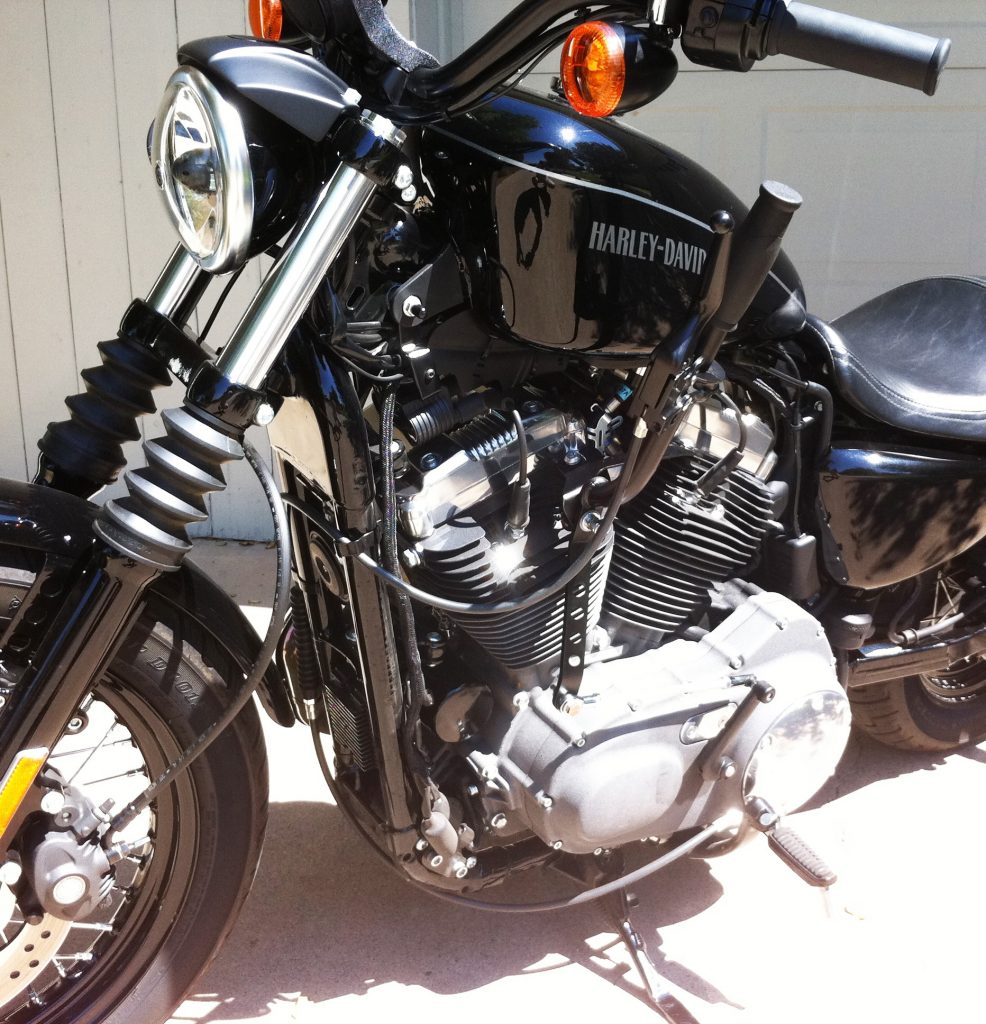
A black Harley-Davidson Sportster with a Widow Maker hand shifter kit
Harley-Davidson Sportster with Widow Maker hand shifter kit | Widow Maker Industries

The Cox-Keino Chief already has an owner, renowned tattoo artist Nikko Hurtado. But you can give your modern motorcycle a hand shifter, too. And it’s not just for those who want to ride vintage-style. I’ve met an older rider who installed one on his ‘90s Harley-Davidson because his arthritis prevented him from using the clutch lever.

In terms of cost, it depends on your bike’s make and model. For comparison, Widow Maker Industries’ Harley-Davidson hand shifter kits start at $240 and run to $450. And the company claims it takes less than an hour to install.

Who knows, perhaps Paul Cox’s and Keino Sasaki’s build will start a new wave of hand-shifting bikes.

Follow more updates from MotorBiscuit on our Facebook page.

RELATED: Is Getting a Motorcycle Slipper Clutch Worth It?

The post This Custom 2022 Indian Chief Rocks a Vintage-Style Hand Shifter appeared first on MotorBiscuit.

by Gabrielle DeSantis

Tesla Motors released its first vehicle in 2008. The electric vehicle and clean energy company has risen to the top of the electric vehicle industry. Tesla shouldn’t get too comfy at the top because seasoned American automaker Ford is on its heels with two new amazing EVs. Tesla and Ford’s electric vehicles are selling by the thousands despite this tumultuous time of economic uncertainty. Which company will dominate the electric future?

Tesla is the problem child that America has grown to love

Tesla co-founder and CEO Elon Musk stands in front of Tesla’s Cybertruck | Frederic J. Brown/AFP via Getty Images

Tesla is nothing if not innovative. The company plays by its own rules (like its CEO Elon Musk) for better or worse. Tesla has introduced features that had not existed in the automotive industry. It has also been scrutinized and painted as controversial for years. Is Tesla the future of automobiles, or is the company falsely advertising its true capabilities?

Tesla’s Autopilot scares and intrigues consumers. Several incidents have occurred due to the Autopilot feature. Its legality is being questioned as some Tesla owners use the feature irresponsibly. The Autopilot feature was designed to help drivers avoid accidents. The feature is having the opposite effect and is now under serious investigation.

Tesla has long been criticized for making claims about the Autopilot feature that don’t add up. While it is marketed as a feature that takes over for the driver, Tesla recently clarified that drivers must be attentive while Autopilot is engaged. Still, despite the controversy surrounding the automaker, it is leading in electric vehicle sales for 2021 with no signs of letting up.

Tesla knows what the people want

A red Tesla Model 3 electric car is seen at the Automobile exhibition area during the third China International Import Expo CIIE in Shanghai, east China, Nov. 6, 2020.
A Tesla Model 3 | Xinhua/Ding Ting via Getty Images

When Tesla models were first introduced to the market, they were expensive luxury performance cars that the average American citizen could not afford. Tesla has continued to produce models that boast amazing performance and are extremely luxurious, but it has also introduced more affordable options.

The folks at Tesla realized to scale the brand, Tesla had to be more accessible. Thus the Tesla Model 3 sedan and Tesla Model Y SUV were given starting prices of $39,999. Electric vehicle tax incentives can bring prices for both vehicles down to under $34,000.

Suddenly most Americans could afford Tesla models, and both the Tesla Model 3 and Model Y offered great battery range. Tesla developed a brand around performance and quality and then gave the average consumer amazing options in the automotive industry’s two most competitive vehicle classes. The Tesla Model 3 quickly became one of the most popular cars in the industry.

Tesla models include several exclusive features such as Arcade Mode and Dog Mode. The company has become synonymous with cutting-edge technology. Assuming that Tesla will continue to dominate EV sales for the years to come would be a fair prediction…if the competition wasn’t so stiff.

America’s favorite just got with the times

2022 Ford Mustang Mach-E with Ice White package.
2022 Ford Mustang Mach-E with Ice White Package | Ford

American automaker Ford has existed for over a century. Unlike Tesla, it has had the luxury of building a reputation through decades of incredible lineups and vehicles. Ford has been through its up and downs, but it has remained one of America’s favorite automakers. Ford has been playing the game for much longer than Tesla, and it knows how to please consumers.

The Ford Mustang is a staple in muscle car culture. The Ford F-150 is the quintessential pickup. Ford owes much of its success to these two nameplates, and it has cleverly staked its future on them. Ford has finally entered the EV race, but instead of starting from scratch like other automakers, it is electrifying some of its flagship models.

The Ford F-150 Lighting is America’s favorite pickup truck but electrified. It also has an awesome frunk and can even function as a power generator. The F-150 Lighting base model can travel 230 miles, which is competitive by today’s electric vehicle battery range standard.

Ford’s answer to the popular Tesla Model Y Suv is the first-ever Mustang SUV…oh, and it’s electric too. The Ford Mustang Mach-E is an electric SUV that boasts power, an attribute usually foreign to electric vehicles. The entry-level Select trim can travel 230 miles on a single charge as well. It can go from 0 to 60 miles per hour in just 5.2 seconds.

Tesla Vs. Ford

The frunk on the 2022 Ford F-150 Lightning is ridiculous
The frunk on the 2022 Ford F-150 Lightning is ridiculous | Ford

Tesla is currently selling more electric vehicle units than Ford. That being said, semiconductor chips have crippled Ford’s vehicle production. Few buyers have been able to get the Ford EVs that they ordered yet. Tesla Model 3 and Tesla Model Y EVs are much more common in person at the moment.

It’s hard to say which company will dominate the electric future, but Tesla has a huge headstart. As long as Autopilot issues don’t worsen, it is smooth sailing for the electric vehicle company. Ford has taken steps to become a contender in the EV space, but the semiconductor shortage has clipped the company’s wings just as it was starting to reach new heights. However, according to Electrek, the Ford F-150 Lighting is still in incredibly high demand despite slow production.

Ford is surprisingly the underdog in this matchup, but it could easily catch up and overtake Tesla depending on the reception of the Ford F-150 Lightning. The future is uncertain, but it will surely be fun to watch. Which American company do you think will dominate the electric future?

RELATED: Ford F-150 Lightning vs. Tesla Cybertruck: The Faster, Stronger, Longer-Range Choice Is Also Cheaper

The post Tesla Vs. Ford: Which Company Will Dominate the Electric Future? appeared first on MotorBiscuit.